Pricing, processing rates, and contract terms may vary by reseller, business type, MCC code, and promotional offer. Always verify official terms in the quote and contract package before signing.
If the shortlist is Shift4 Dine vs Clover, the real question is not which brand looks bigger. It is which system fits restaurant operations better once pricing, hardware, processing, and setup are actually on the table.
“When owners compare POS quotes, the mistake is usually the same: they compare the headline monthly number and ignore workflow, processing lock-in, and what the team will actually use on a Friday night. In restaurants, that is where the real cost shows up.” — Max Artemenko, POS Systems Expert & Product Architect, Shift4 Dine Partners
A quick note before the side-by-side. There is no reliable independent comparative study for Shift4 Dine vs Clover that meets strict research-grade standards — no peer-reviewed benchmarks exist for this comparison as of publication. This article is built from official product pages, official documentation, contract materials, and implementation experience. That matters because pricing, processing, and support can vary by reseller, location, and business type.
Shift4 Dine vs Clover at a Glance
For restaurants, the short version is simple. Clover is a broader POS ecosystem with flexible hardware and an app marketplace. Shift4 Dine is a restaurant-first system built around Shift4 payments with more built-in restaurant workflow out of the box.
When comparing Clover vs Shift4, the biggest difference is operating model. Clover is closer to a platform you configure. Shift4 Dine is closer to a restaurant package you deploy.
| Shift4 Dine | Clover | |
|---|---|---|
| Pros | Restaurant-native workflow; $0 upfront hardware; bundled KDS, loyalty, online ordering; one unified stack | Broad hardware lineup; 400+ app marketplace; buy-and-own devices; flexible across industries |
| Cons | Locked to Shift4 processing; 36-month agreement; less hardware ownership flexibility | Higher upfront hardware cost; restaurant depth may require paid apps; reseller variability |
| Feature | Shift4 Dine | Clover |
|---|---|---|
| Positioning | Restaurant POS | Multi-industry POS with restaurant mode |
| Entry pricing | Starts at $29.99/month per terminal | Software and hardware priced separately |
| Upfront hardware | $0 upfront in bundle offers | Usually purchased upfront or financed |
| Processing | Built around Shift4 payments | Clover/Fiserv rates; vary by plan and reseller |
| Handheld ordering | Core restaurant use case | Available via Clover Flex |
| KDS | Built-in restaurant positioning | Available; setup may depend on configuration |
| Online ordering | Built into restaurant package | Available through Clover tools and apps |
| Loyalty program | Included in Shift4 Dine bundle | Available via Clover ecosystem and add-ons |
| Back office | Lighthouse back office | Clover Dashboard + app ecosystem |
| Contract terms | Tied to Shift4 processing agreement | Terms vary by reseller/bank/channel |
| App marketplace | Smaller, restaurant-focused catalog | Strong 400+ app marketplace |
| Best for | Full-service restaurants, QSR, bars | Retail, cafés, mixed-format SMBs |
Clover describes itself as a POS solution for food and beverage and other industries. Shift4 Dine describes itself as a restaurant POS system. Shift4’s official release notes confirm the rebrand: “SkyTab POS is now officially Shift4 Dine.” — Shift4 release notes, May 2026, releasenotes.shift4.com
Is SkyTab the Same as Shift4 Dine?
Yes. SkyTab and Shift4 Dine are the same restaurant POS product line. SkyTab was the previous brand name. Shift4 officially renamed it to Shift4 Dine on May 12, 2026.
That matters because many buyers still search skytab vs clover, clover vs skytab for restaurants, or land on older partner pages and reviews under the SkyTab name. The official position is clear: this was a rebrand, not a separate new POS with a different core feature set. The announcement states “SkyTab POS is now officially Shift4 Dine,” with the new name reflected across communications and inside the system itself.
| What Changed | What Stayed the Same |
|---|---|
| Product name (SkyTab → Shift4 Dine) | Software, features, and interface |
| Branding across materials | Pricing ($29.99/mo per terminal) |
| Website (skytab.com → dine.shift4.com) | Hardware and merchant accounts |
| Shift4 processing requirement and contract terms |
In practical terms: SkyTab = former name. Shift4 Dine = current name. The restaurant comparison intent is the same either way.
For more detail on what changed during the rebrand, see SkyTab POS System Now Shift4 Dine.
That is also why this article treats Shift4, SkyTab, and Shift4 Dine carefully. Shift4 is the company and payment stack. Shift4 Dine, formerly SkyTab POS, is the restaurant POS product.
The Short Answer: Which System Fits Which Business?
If the business is a full-service restaurant, QSR, bar, or café that wants restaurant workflow built in from day one, Shift4 Dine usually fits better. If the business wants broader small-business flexibility, more app-driven customization, or a mixed retail-plus-food model, Clover can fit better.
In practice, the split often looks like this:
- Choose Clover for lighter food service, mixed-use concepts, or businesses that prefer assembling tools through an app marketplace.
- Choose Shift4 Dine for table service, coursing, kitchen routing, handheld ordering, and a more unified restaurant stack.
In one migration project from an older mixed POS setup, the restaurant wanted mobile ordering, split checks, KDS flow, and online orders in one package. We simplified the menu tree, mapped kitchen routing, and trained staff by role. The result was smoother service during peak hours and fewer order-entry mistakes in the first launch week.
“The system itself is so user friendly and their staff made the conversion so seamless. They have 24-hour customer service available at any time.” — Max Artemenko, POS Systems Expert & Product Architect, Shift4 Dine Partners (Client Case #5)
What Clover and Shift4 Dine Actually Are
Before comparing cost, it helps to understand the product models. Clover is a Fiserv-led POS ecosystem spanning multiple industries. Shift4 Dine is a restaurant POS layer tied closely to Shift4 payments.
This is not a small difference. It shapes hardware, contracts, integrations, and onboarding — everything downstream from the initial purchase decision.
Clover: Hardware-First POS Tied to the Clover Ecosystem
Clover is best understood as a hardware-plus-software platform. Fiserv positions Clover as an all-in-one Android POS environment for SMBs — used by more than 700,000 businesses across the United States — where hardware, software, payments, reporting, and inventory sit inside one ecosystem.
That is why Clover Station and Clover Flex matter so much in the buying process. The hardware is a large part of the offer.
Clover’s strengths are clear:
- Multiple device types (Go, Flex, Mini, Station Solo, Station Duo)
- Broad SMB positioning across retail, service, and food
- Strong 400+ app marketplace
- Flexible use across restaurant, retail, and service categories
- Option to own hardware outright
But that flexibility comes with a trade-off. Restaurants often need more setup decisions upfront: which plan, which hardware mix, which apps, which reseller support model, which processing terms. Official Clover materials show monthly software plans plus published transaction rates, while the App Market extends functionality through add-ons.
Best for: Retail stores, salons, service businesses, cafés, and operations that blend retail with food service and want one system across all formats.
Shift4 Dine: Restaurant POS Built Around Shift4 Payments
Shift4 Dine is a restaurant POS built around Shift4 payments. Its public positioning is less “choose your ecosystem” and more “deploy a restaurant package.”
That package-oriented model is the main reason many restaurants shortlist it. Shift4 Dine promotes bundled restaurant software, bundled support, and $0 upfront hardware tied to Shift4 processing. It also emphasizes restaurant workflows such as:
- Handheld ordering (tableside, curbside, reorders mid-meal)
- Kitchen display system (color-coded tickets, timers, routing)
- Online ordering (native, not app-dependent)
- Loyalty and guest surveys
- Reservations and waitlist
- Back-office reporting through Lighthouse
From implementation experience, this is why Shift4 Dine often feels clearer during restaurant demos. The workflow is closer to how the floor and kitchen already operate. Less translation is needed between what the system does and what the team actually needs.
A common pattern: an owner compares Clover Station plus apps against Shift4 Dine with bundled modules. On paper, Clover may look more open. On the floor, Shift4 Dine often looks more restaurant-native.
Best for: Full-service restaurants, bars, QSR, and food trucks that want restaurant features out of the box and prefer a low monthly fee over owning hardware outright.
Pricing, Fees, and the Real Monthly Cost
Disclaimer: The information below is general in nature. Prices and rates are current as of publication and do not replace an official cost estimate. Always verify exact terms with your provider before signing.
If the question is price, the direct answer is this: Shift4 Dine usually wins on upfront cost, while Clover is easier to parse line by line on public pricing pages. Which option is cheaper over time depends on terminal count, processing volume, apps, and contract terms.
For official Shift4 Dine pricing details, see SkyTab Price & POS System Pricing.
| Cost Area | Shift4 Dine | Clover |
|---|---|---|
| Software subscription | $29.99/month per terminal (public standard rate) | $0–$129.85/mo by business type and plan |
| In-person processing rates | 2.75% + $0.15 (public base rate) | 2.3%–2.6% + $0.10 depending on plan/reseller |
| Online/keyed rates | Included in blended rate; online ordering built in | 3.5% + $0.10 on most plans |
| Hardware cost | $0 upfront (with processing agreement) | Purchased outright or financed |
| Contract sensitivity | High — hardware and processing are linked | High — reseller structure can change terms |
| PCI compliance | Included; no separate fee | Varies by provider; may carry monthly fee |
| Annual fees | Some merchants report ~$400–$500/device/year; confirm in writing | None standard when buying direct |
Clover Pricing by Business Type
Clover does not use a universal plan list. It is priced by industry, and the numbers vary significantly based on your business type:
| Business Type | Hardware (one-time) | Software (monthly) | Or finance over 36 months |
|---|---|---|---|
| Retail | $349–$2,648 | $84.95–$104.90 | $16–$240/mo |
| Quick-service restaurant | $849–$2,648 | $89.95–$109.90 | $135–$245/mo |
| Full-service restaurant | $1,799–$4,447 | $89.95–$129.85 | $179–$354/mo |
| Personal services | $349–$1,899 | $84.95 | $16–$180/mo |
| Professional services | Quoted separately | $0–$84.95 | Software only |
| Home and field services | $0–$749 | $29.95–$84.95 | Up to $125/mo |
Source: Clover pricing, clover.com/pricing, 2025
Clover hardware prices at the device level: Go $199, Compact $349, Flex Pocket $699, Flex $749, Mini $849, Station Solo $1,799, Station Duo $1,899. — Clover.com direct pricing, 2025; Front Desk Review, frontdeskreview.com/software/pos-systems/clover/
Software and Payment Processing Fees
For monthly fees, Clover is more modular. Shift4 Dine is more bundled.
Clover publishes plan and rate information more openly, but the total can expand through hardware purchase or financing, software subscription tier, processing rate by plan, app fees, reseller-added fees, and PCI or statement charges.
Shift4 Dine compresses more of the restaurant stack into the pitch. That lowers entry friction, but it can make the final economics harder to compare unless the quote is fully itemized. Fees eat margin either way — the question is which line items are visible before you sign.
For processing specifically:
- Clover: 2.3%–2.6% + $0.10 in-person, depending on plan/reseller; 3.5% + $0.10 keyed or online
- Shift4 Dine: 2.75% + $0.15 public base rate; some partner sources cite negotiated rates of 2.40%–2.55% + $0.10–$0.15 for higher volumes
This is where owners get tripped up. A lower or higher swipe rate by itself does not decide the deal. Ticket average, card mix, number of terminals, and app load all matter.
What “Free Hardware” and Low Upfront Offers Really Mean
$0 upfront hardware is real as a sales structure, but it is not free ownership. It usually means the cost is recovered through the broader agreement over time. For more on the economics of this model, see How the Free Hardware Model Works.
For Shift4 Dine, the offer requires a Merchant Processing Agreement and a POS Service Agreement, with additional terms applying. Public examples point to a 36-month structure. The hardware remains Shift4’s property; you return it on cancellation.
That does not make it a bad deal. For many restaurants, avoiding a large upfront hardware check is a smart cash-flow move. But owners should ask:
- Who owns the hardware at the end?
- What is included in the base package?
- Are handhelds included or separate?
- What happens on early termination?
- Are support and replacements included?
In one bar deployment, the owner focused only on “no upfront hardware.” We slowed the decision down, broke out workstation count, handheld count, and online-ordering needs, then compared the 36-month cost to a buy-now alternative. The result was a cleaner decision — and no surprise when add-on handhelds landed outside the base bundle.
How to Estimate Your Real Monthly Cost
Start with five inputs:
- Number of fixed terminals
- Number of handheld ordering devices
- Average monthly card volume
- Average ticket count
- Restaurant features that require paid add-ons or separate devices
Then map the cost buckets: software subscription, processing rates, hardware repayment or financing, add-on apps, online ordering fees, loyalty program fees, support or PCI fees if present.
For a small café, Clover may look fine if one counter station and one handheld cover most of the business. For a full-service restaurant with table service, split checks, KDS, and online ordering, Shift4 Dine can become more economical because fewer restaurant functions need to be layered in separately.
Pricing, processing rates, and contract terms can vary by reseller, business type, and current promotional offer. The figures above reflect publicly available information as of publication. Always verify official terms in the quote and contract package before signing — what a sales rep says verbally and what the contract says are sometimes two different things.
36-Month Total Cost of Ownership (TCO)
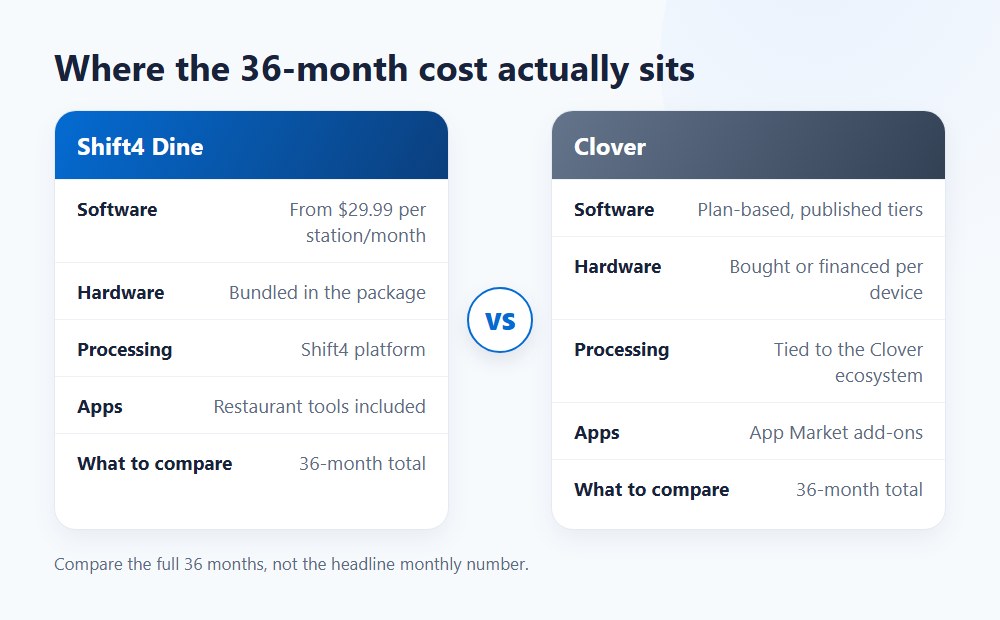
The monthly software fee is the smallest number that matters. Your processing rate and total contract economics determine what you actually pay over the life of the system.
Here is a worked example for a restaurant processing $40,000/month in card sales at a $40 average ticket (1,000 transactions):
| Cost Item | Shift4 Dine | Clover (QSR Standard) |
|---|---|---|
| Monthly software | $29.99 | $89.95 |
| Monthly processing | ~$1,250 (2.75% + $0.15) | ~$1,100 (2.5% + $0.10) |
| Monthly total | ~$1,280 | ~$1,190 |
| Hardware upfront | $0 | $1,899 (one Station) |
| 36-month total | ~$46,080 | ~$44,740 |
A 0.25% difference in processing rate on $40,000/month is $100/month — or $3,600 over 36 months. That single rate gap costs more than buying the Clover hardware outright. The monthly software fee is noise. Your processing rate, and whether you can negotiate it, is the number that decides the real cost.
However, the software-only TCO calculation is also worth understanding: at $29.99/month per workstation over 36 months, the base Shift4 Dine recurring cost for software alone is $1,079.64. That figure excludes processing. At $40,000/month card volume, processing adds roughly $45,000 over those 36 months — making software a small fraction of your actual spend.
Example assumes flat-rate processing and standard published software pricing. Negotiated interchange-plus rates, added devices, app subscriptions, and sales volume will all move these totals. Confirm every figure in writing before signing.
Contract Terms and Processor Lock-In
Both products involve lock-in. Shift4 Dine locks more directly around processing. Clover lock-in is often shaped more by hardware, reseller, and channel structure.
Shift4 Dine and Processor Lock-In
Shift4 Dine is built around Shift4 payments. If a restaurant wants the Dine bundle and the low-upfront model, the processing relationship is part of the deal.
The upside: cleaner bundle, fewer integration gaps, one core stack. The downside: less pricing flexibility if you want to shop processors later; switching costs if you leave; contract review becomes critical.
Available contract materials show that Shift4 termination terms can be tied to remaining service fees. The Early Termination Fee equals the average monthly gateway service fees multiplied by the months remaining in the term. Notably, if the merchant simultaneously terminates their Merchant Processing Agreement with a Shift4 affiliate, the Early Termination Fee is waived — but that only matters if you are leaving the entire Shift4 ecosystem. That does not mean every Dine agreement works the same way. It means owners need the exact paperwork, not a verbal summary. — Shift4 Gateway Services Agreement Terms and Conditions, 2025
Clover, Resellers, and Contract Variability
Clover is more variable because the brand sits across Fiserv, banks, and resellers. That is why two Clover quotes can feel like two different products.
The platform is the same. The commercial wrapper may not be.
Research inputs show Clover terms and pricing can change based on: reseller, bank partner, business type, MCC code, selected software plan, and hardware bundle. This variability is one of Clover’s biggest strengths and one of its biggest risks. Buying direct from Clover.com can keep you month-to-month. Buying from a reseller may mean a 36–48 month contract with early termination fees above $500.
The device links to your merchant account, so it loses most of its function if you cancel — even though you paid for it outright. Banks love opacity, and this is one of the places it shows up.
What to Check Before You Sign or Switch
| Contract Checkpoint | Why It Matters |
|---|---|
| Full recurring cost | Catches software, app, PCI, platform, statement, and support charges |
| Term and auto-renewal | Prevents rollover surprises |
| Early termination rules | Shows the real exit cost |
| Data export rights | Important if you switch later |
| Hardware ownership/return | Clarifies buyout or return obligations |
This is also the right time to ask one blunt question: Can I use my own payment processor with Clover or Shift4 Dine? In most restaurant deals on this shortlist, assume the answer is limited or no unless explicitly documented in writing. Shift4 Dine requires Shift4 processing with no alternative. Clover uses Fiserv by default and allows outside processors only on select plans, often at higher cost and with reduced features — and only where the reseller/bank has agreed to it in writing.
Hardware Compared: Clover Station, Clover Flex, and Shift4 Dine Devices
For restaurant hardware, the practical answer is this: Clover offers a clearer public device lineup with explicit pricing. Shift4 Dine is sold as a restaurant-ready hardware bundle with mobility options included in the base offer.
| Device Category | Clover (Buy Outright) | Shift4 Dine (Included in Bundle) |
|---|---|---|
| Mobile card reader | Clover Go ($199) | Not offered as standalone |
| Handheld / tableside | Clover Flex ($749, built-in printer/scanner); Flex Pocket ($699) | Handheld terminal + 8″ tableside Tablet |
| Countertop terminal | Compact ($349), Mini ($849, 8″), Station Solo ($1,799, 14″) | Workstation with integrated customer display |
| Customer-facing screen | Station Duo ($1,899; dual 14″ + 8″) | Integrated in Workstation or standalone CFD |
| Kitchen display (KDS) | Add-on device + app fee | 16″ or 22″ touchscreen; optional bump bar |
| Self-service kiosk | Clover Kiosk (24″ with printer; priced on request) | Kiosk (self-service with digital receipts) |
| Peripherals | Star, Zebra, CAS third-party brands | Vendor-specified models |
| Cost model | Buy outright or finance over 36 months | $0 upfront; standard kit with active Shift4 processing |
| Ownership | You own it, but ties to merchant account | Shift4 retains ownership; returned on cancellation |
Important note for Clover buyers: First-generation Station, Mini, and Flex devices have reached end of support. Confirm you are getting Gen 2 or newer hardware before signing.
Countertop vs Handheld Hardware for Restaurant Service
In restaurants, the hardware decision is not just countertop vs mobile. It is where orders start, where payments finish, and how often staff walks back to a station.
Official Clover documentation describes Clover Flex as a handheld with a 5.99-inch screen, Android 10, Snapdragon 660, 2 GB RAM, 16 GB flash, built-in printer, and support for EMV/NFC/MSR. Battery life is listed as at least 8 hours. — Clover developer docs, docs.clover.com/dev/docs/clover-devices-tech-specs, 2025
That makes Flex a legitimate restaurant device, not just a card reader. For detailed Shift4 Dine mobile hardware specifications, see the SkyTab Mobile terminal page.
A useful operational rule:
- More counter service = countertop matters more
- More table service = handhelds matter more
- More kitchen complexity = routing and KDS matter more than screen size
Can You Keep Your Current Hardware If You Switch?
Usually, no. Do not assume Clover hardware can be reused on Shift4 Dine, or vice versa. Both stacks rely on their own device ecosystems, firmware paths, and platform controls. Clover hardware works with Fiserv/Clover; Shift4 Dine hardware is not designed to be transferred or reprogrammed to another provider. — Merchant Cost Consulting, 2025
If switching is on the table, treat hardware reuse as NO unless the vendor confirms it in writing. Plan the hardware budget as a fresh line item, not a carryover.
Hardware Warranty and Replacement
This question matters most for operators considering the Shift4 Dine $0 upfront model. Since Shift4 retains hardware ownership while you are under contract, the hardware comes with a lifetime warranty for the duration of your active service agreement. If a terminal fails, Shift4 is responsible for replacement — not you.
Several client testimonials from Shift4 Dine Partners deployments specifically mention next-day technician visits and strong 24/7 support availability: “I really love that they have real technicians that come to assist next day. And their customer service is excellent 24/7.”
For Clover, warranty terms vary by device and reseller. Since you own the hardware outright, replacement costs fall on you after the manufacturer warranty period ends.
Restaurant Features That Matter Most
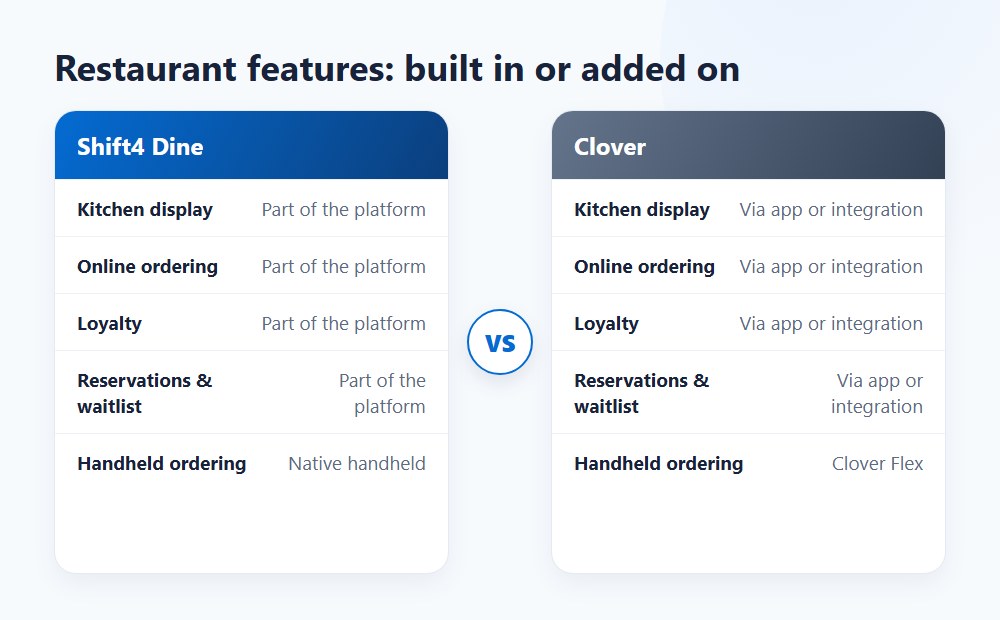
For restaurants, features matter more than logos. Shift4 Dine has the advantage when built-in restaurant workflow is the priority. Clover stays competitive when the restaurant wants flexibility and is comfortable assembling pieces through its ecosystem.
| Restaurant Scenario | Shift4 Dine | Clover |
|---|---|---|
| Dine-in table service | Strong fit; built-in coursing, floor maps | Can fit with right plan and configuration |
| Quick service | Strong fit | Good fit for lighter QSR |
| Mobile ordering | Built into positioning; tableside native | Supported via Clover Flex and online tools |
| Kitchen workflow | KDS-first; built-in routing templates | Routing available; often more configuration-sensitive |
| Guest retention | Loyalty, surveys, reservations bundled | Loyalty available; often ecosystem-dependent |
| Restaurant Feature | Clover | Shift4 Dine |
|---|---|---|
| Table management and floor plans | Full-service restaurant plan | Built in |
| Course firing / coursing | Full-service restaurant plan | Built in |
| Kitchen display (KDS) | Add-on device + app fee | Built in |
| Tableside ordering and payment | Clover Flex handheld | Shift4 Dine Handheld |
| Online ordering | Via app, some free, some paid | Built in, native |
| Reservations | Via third-party app | Built in |
| Loyalty program | Via app (often paid) | Built in |
| Guest surveys | Not in core platform | Built in |
Handheld Ordering and Tableside Service
Both can do handheld ordering. Shift4 Dine is more explicitly designed around restaurant tableside flow. Clover Flex is capable, but the overall system still feels broader than restaurant-only.
Clover Flex supports tableside ordering, payments, receipt printing, and real-time sync with other Clover devices. Shift4 Dine’s mobile-ordering materials emphasize tableside ordering, reorders during the meal, added items after the initial order, and split checks.
I have seen this matter most in busy dining rooms. One full-service concept had servers bouncing between station and table for check changes and add-ons. We moved the flow to handheld-first, cleaned modifier logic, and tightened floor sections. Service became faster and staff stopped clustering around the counter during rush periods. That is the kind of change that shows up in table turns, not just in a demo.
Kitchen Display, Online Ordering, and Loyalty Tools
Shift4 Dine has the stronger restaurant-first message here. Public materials describe kitchen display system, online ordering, loyalty, reservations, waitlist, and guest tools as part of one platform story — nothing on that list is a paid add-on.
Clover supports online ordering and kitchen routing as well. The difference is often packaging. Clover’s ecosystem may rely more on specific plan choices or add-ons, while Shift4 Dine markets these functions as part of the restaurant stack.
This matters because restaurant operators do not buy features in isolation. They buy order flow: guest places order → kitchen gets it correctly → front of house sees status → guest comes back. That full loop is where built-in modules usually beat pieced-together stacks.
Lighthouse Back Office vs Clover App Ecosystem
For more on Lighthouse capabilities, see SkyTab Lighthouse: Elevate Your Enterprise.
Research inputs show Lighthouse includes:
- Sales reports (X/Z, Sales Summary, COGS)
- Labor reports (time clock, pay rates, earnings, taxes)
- Inventory reports (current stock, quantity, cost, price, status)
- Multi-location filters
- Settlement comparisons
Clover Dashboard also covers sales, staff, inventory, and customer loyalty management, but Clover’s broader model leans more into the marketplace path when businesses want to expand capability.
The trade-off is simple:
- Lighthouse: more built-in restaurant operations depth, fewer integrations needed
- Clover marketplace: more app-driven breadth, more flexibility to add niche tools
Ease of Use, Setup, Onboarding, and Support
Neither system is “plug it in and forget it” for a serious restaurant. Shift4 Dine is usually easier when the restaurant wants a guided restaurant deployment. Clover is usually easier when the business is simpler or already comfortable managing app configurations.
Setup Experience for Shift4 Dine
Shift4 Dine setup follows a structured restaurant onboarding pattern. Available source data points to an Onboarding Wizard covering contact details, shipping, installation date, menu upload, and tax confirmation, followed by floor plan configuration through table layout tools in Customer Hub or Lighthouse.
The heavy lift in restaurant POS is not plugging in hardware. It is menu structure, modifiers, taxes, routing, floor maps, staff permissions, and payment flow.
Internal partner materials put menu build at 2–7 days depending on complexity (simple: 1–2 days, standard: 3–4 days, complex: 5–7 days), and staff training at 30–60 minutes for core tasks or 2–3 hours across a shift by role. For staff training resources, see Restaurant POS Staff Training.
Shift4 Dine also includes free professional installation by technicians — a meaningful differentiator compared to self-setup models. Support is 24/7 by phone and online, provided directly by Shift4 (not a reseller).
Setup Experience for Clover
Clover setup depends more on the seller path. The product setup is one thing. The reseller setup experience is another.
Officially, owners access the App Market through Clover Dashboard, search apps, and install what they need. But the real-world setup experience varies based on whether the seller offers guided onboarding, remote install help, vertical expertise, or just ships the box.
Clover training references range from 20 minutes to 2 hours depending on task and format — realistic for a simpler environment, but it does not answer the harder restaurant question, which is configuration quality. Reseller-dependent support is Clover’s most cited pain point in reviews.
| Factor | Clover | Shift4 Dine |
|---|---|---|
| Interface | Tablet-style; familiar to most staff | Built around restaurant workflows |
| Installation | Self-setup or paid reseller help | Free professional installation |
| Training | Self-guided; reseller-dependent | Included; on-site and on-demand |
| Support hours | 24/7 phone and chat | 24/7 phone and online |
| Support consistency | Varies by reseller or ISO | Direct from Shift4; some users report slower response during peak periods |
Integrations, Apps, and Business Flexibility
If flexibility means “add tools as needed,” Clover has the edge. If flexibility means “run restaurant operations with fewer moving parts,” Shift4 Dine has the edge.
| Integration Type | Clover | Shift4 Dine |
|---|---|---|
| App marketplace | 400+ apps across categories | Smaller catalog; core tools built in |
| Delivery | DoorDash, Uber Eats via apps | DoorDash, Uber Eats; native online ordering |
| Accounting | QuickBooks, Xero via apps | QuickBooks, Xero |
| Labor / scheduling | App Market options | 7shifts and built-in scheduling |
| Hotel / PMS | Via apps | Oracle OPERA, InnQuest, Ezee |
| Developer API | Yes, open developer platform | Yes, for custom integrations |
Clover’s App Marketplace and Add-On Model
Clover’s app marketplace is one of its strongest differentiators. The merchant can install approved apps, manage subscriptions, and extend the base system through third-party tools.
But app-led expansion has a real cost pattern. A typical third-party app range is $5–$50 per month. Some restaurant management or reservation tools run higher: reservations apps at $49–$79/month, accounting integrations at $24.95–$46.95/month, restaurant management apps at $149/month, and delivery integration bundles up to $75/month in reseller estimates.
So Clover can start simple and grow. It can also become fragmented — and expensive — if nobody owns the stack properly. The app marketplace is a feature when you manage it. It is a markup trap when you do not.
Shift4 Dine’s Built-In Workflow and Back-Office Tools
Shift4 Dine scales differently. The selling point is not app count. It is native restaurant workflow.
Public materials describe an all-in-one restaurant approach with online ordering, marketing and loyalty, reservations, waitlist, QR ordering, and back-office tools built into one platform story. That usually reduces app hunting and integration sprawl.
For owners, the advantage is less app administration. For managers, the advantage is fewer “why doesn’t this sync?” moments. For multi-unit restaurant operations, this can be a significant operational advantage — one fewer vendor to call when something breaks on a Saturday night.
Payout Speed and Offline Mode
These two topics rarely appear in POS comparisons, but they are among the most practical concerns for restaurant operators. A cash-flow gap caused by slow funding can be just as painful as a processing outage on a busy Friday night.
Payout Speed (Funding Speed)
Shift4 Dine processes payments through Shift4’s proprietary payment platform. Shift4 offers next-business-day funding as the standard for most merchants, with same-day funding available in certain configurations. Given that Shift4 controls both the POS and the payment layer, funding is generally predictable with fewer intermediaries involved.
Clover funding speed depends significantly on your reseller and the underlying acquirer. When buying direct from Clover/Fiserv, merchants typically receive next-business-day deposits. Through third-party resellers, funding timelines can vary — some resellers use non-Fiserv acquiring banks, which can introduce delays. Always confirm the exact funding timeline in writing before signing with any Clover reseller.
Bottom line: For funding predictability, Shift4 Dine’s vertical integration is an advantage. With Clover, funding reliability depends on your specific reseller and processing agreement.
Offline Mode (What Happens When Wi-Fi Fails)
Shift4 Dine supports an offline mode that allows terminals to continue accepting card payments when the internet connection is interrupted. Transactions are queued locally and transmitted to Shift4’s servers once connectivity is restored. This is critical for restaurants where a dropped connection during a dinner rush cannot mean a complete halt in service.
Clover also includes offline payment capability on most plans. Clover’s offline mode stores card data locally and processes transactions when the connection returns. However, some Clover plans and configurations have limitations on the number of transactions or total dollar amount that can be processed offline before the terminal locks. Check with your reseller or Clover directly to confirm offline limits on your specific plan.
Bottom line: Both systems have offline capability. Shift4 Dine’s offline mode is tightly integrated with the restaurant POS layer. For Clover, confirm offline transaction limits with your specific reseller before deployment.
Where Clover or Shift4 Dine Fit Best by Business Type
The best fit is not mysterious. Shift4 Dine fits restaurants better. Clover fits a wider range of small businesses better.
Best Fit for Restaurants and Hospitality
For full-service restaurants, QSR, bars, and cafés that care about:
- Handheld ordering
- KDS flow
- Online ordering
- Split checks and table service
- Floor management and coursing
Shift4 Dine is usually the stronger fit. This is especially true when the owner wants one operational stack instead of a hardware-plus-app assembly project. For restaurants processing above $30,000/month in card volume, the bundled approach also tends to simplify the monthly cost conversation.
Best Fit for Small Businesses Outside Full-Service Restaurant Workflows
For lighter-service businesses or businesses outside full-service restaurant complexity, Clover can be the better fit:
- Café with light food and retail items
- Bakery with counter service
- Mixed retail + beverage concept
- Service business that also takes counter payments
In those cases, Clover’s broader SMB logic and app flexibility can be more useful than a restaurant-heavy package. The system does not need to know about coursing or kitchen routing if the business is a coffee counter with three SKUs.
When to Consider a Clover Restaurant POS Alternative
A Clover restaurant POS alternative becomes worth considering when Clover starts to feel like too many parts for a restaurant workflow that should be native.
Consider shifting away from Clover if the business needs:
- Deep table-service logic
- Dependable kitchen routing by item/modifier
- Tighter handheld-to-kitchen flow
- Bundled restaurant tools instead of layered apps
- Lower upfront hardware outlay
This is where Shift4 Dine vs Clover becomes less about brand and more about restaurant friction.
SkyTab vs Clover vs Toast: Where Shift4 Dine Sits in the Wider Market
If the shortlist expands to three systems, the clean takeaway is this: Toast and Shift4 Dine are more restaurant-specialized. Clover is broader and more ecosystem-driven.
| Platform | Restaurant Focus | Handheld Ordering | Online Ordering | Loyalty | Hardware Approach |
|---|---|---|---|---|---|
| Shift4 Dine (formerly SkyTab) | Strong restaurant focus | Yes, built in | Yes, native | Yes, built in | Proprietary/bundled; $0 upfront |
| Toast | Strong restaurant focus | Yes | Yes | Yes | Proprietary restaurant stack |
| Clover | Food & beverage plus wider SMB | Yes | Yes | Available | Device ecosystem; buy outright |
Toast’s public pricing includes a $0/month Starter Kit, a $69/month POS plan, and custom pricing tiers, with in-person processing typically at 2.49% + $0.15 on paid plans. — Toast Pricing & Plans, toast.com/pricing, 2025
For a detailed Shift4 Dine vs Toast comparison, see Shift4 Dine vs Toast: Which Restaurant POS Fits.
SkyTab vs Clover for Restaurants
If someone still searches skytab vs clover, the comparison still points to the same answer. Formerly SkyTab, now Shift4 Dine, is usually better for restaurants that want the POS to behave like a restaurant tool on day one. Clover is more attractive when flexibility across business types matters more than restaurant specialization.
The rebrand did not change the product logic. It changed the name on the box. The restaurant workflow, the Shift4 payments tie-in, and the $0 upfront hardware model are all the same.
When Toast Enters the Shortlist
Toast usually enters when the buyer wants another restaurant-native benchmark. If the shortlist is Toast, Clover, and Shift4 Dine:
- Compare restaurant workflow first
- Compare long-term fees second
- Compare hardware third
- Compare contract exit terms before signing anything
Both Toast and Shift4 Dine are restaurant-first. The processing rate and contract structure are where they diverge most. Clover is the outlier in this group — broader by design, not a restaurant-native system.
Reviews, Ratings, and Common Buyer Concerns
Public reviews help identify patterns. They do not replace quote review or contract review. The best use of ratings is to spot repeated concerns that deserve verification before you sign anything.
| Source | Clover | Shift4 |
|---|---|---|
| Capterra | 3.8/5 (560+ reviews) | 3.5/5 (115 reviews) |
| G2 | 3.8/5 (100+ reviews) | 3.2/5 (fewer than 50 reviews) |
| Trustpilot | 2.8/5 (2,000+ reviews) | 4.5/5 (800+ reviews) |
Sources: Capterra (capterra.com/p/226864/Clover/reviews/, capterra.com/p/70936/Shift4/reviews/), 2025. G2 and Trustpilot ratings from industry comparison sources; direct verification recommended.
An independent study ranked SkyTab first in customer satisfaction at 4.29 out of 5, with 93% of customers reporting no plans to switch.
Positive Patterns Users Mention
For Clover, users tend to like: device variety, ease for smaller businesses, broad tool access, and familiar ecosystem feel.
For Shift4-linked restaurant deployments, positive patterns center on: mobility, restaurant workflow, all-in-one feel, and strong support during conversion. Multiple client testimonials from Shift4 Dine Partners deployments specifically highlight smooth transitions, 24/7 availability, and responsive support:
“Max demonstrated strong technical knowledge, which greatly contributed to the successful transition to the new system. His commitment to being accessible and supportive throughout the transition process was noteworthy.”
“He is always ready to help with chargebacks, responds quickly and processes all documents.”
Common Complaints to Verify Before Buying
Three complaint themes repeat most often across this category:
- Hidden or poorly explained fees — Clover and Shift4 both have documented complaints about unexpected monthly, annual, or statement fees not clear at signing.
- Contract or renewal surprises — Both platforms have reports of auto-renewal issues; Shift4 has 167 BBB complaints over 3 years (101 closed in the last 12 months), many citing renewal charges and early termination fees.
- Support quality varying by provider or channel — Particularly acute for Clover, where reseller quality is the primary driver of support experience.
Before buying, verify: total monthly fees, processing rate by channel, auto-renewal terms, termination fee, included hardware count, app cost stack, and support path after install. If the sales rep cannot give you a written breakdown of all of those, the quote is not ready.
Who Should Choose Clover vs Shift4 Dine
Here is the practical verdict. Choose Clover for flexibility. Choose Shift4 Dine for restaurant-first workflow.
Choose Clover If You Want More App-Driven Flexibility
Choose Clover if the business values:
- Broader small-business use cases (retail, service, mixed-format)
- App marketplace expansion with 400+ tools
- Flexible device selection — own hardware outright
- Lighter restaurant complexity
- Mixed retail/service/food workflows
- Ability to negotiate processing rates through reseller selection
Choose Shift4 Dine If You Want Restaurant-First Workflow
Choose Shift4 Dine if the business values:
- Built-in restaurant logic (coursing, routing, table management)
- Handheld ordering native to the platform
- Kitchen display system included
- Online ordering without additional app costs
- Lighthouse back office for unified reporting
- $0 upfront hardware and lower cash-flow entry
- Professional installation and 24/7 direct support
- One stack aligned to restaurant service
For most full-service and QSR restaurants comparing offers today, this is the main takeaway: Shift4 Dine is the better operational fit, while Clover is the better fit for businesses that want a more general POS ecosystem.
Ready to see what Shift4 Dine looks like for your specific restaurant setup? You can review pricing and hardware options at Shift4 Dine Partners pricing, or reach the team directly through the contact page.