This comparison is based on publicly available vendor materials, third-party review data, partner documentation, and implementation experience. Pricing figures reflect 2025–2026 sources and should be verified directly with vendors before signing.
If you read SpotOn’s own comparison against SkyTab and came away unsure, that reaction is fair. Vendor comparison pages are built to frame the story in their favor. The useful question is simpler: which system actually works better for your restaurant once you factor in real pricing, processing rates, hardware structure, service flow, and what support looks like after launch?
“In real restaurant projects, the wrong POS usually doesn’t fail in the demo. It fails on a busy shift, during split checks, modifiers, and payment handoff between the floor and the kitchen. That’s the level I look at when comparing Shift4 Dine and SpotOn.” — Max Artemenko, POS Systems Expert & Product Architect, Shift4 Dine Partners
One important note before we start: SkyTab POS was officially renamed Shift4 Dine in May 2026. Same product, new name — not a different platform. Shift4’s release notes confirm that SkyTab POS is now Shift4 Dine, with the core product, interface, and feature set unchanged under the new branding (Shift4 release notes, 2026). You can read more about what changed — and what didn’t — at SkyTab POS is now Shift4 Dine.
According to 2026 market scans of 230,000+ US restaurant websites by RestaurantTools.ai, SpotOn holds roughly 2.8% market share among detectable POS stacks, while Toast leads at 38.6% and Square at 18.3%. Shift4 Dine is targeting rapid growth through its $0-upfront model. Real adoption numbers — not vendor claims.
This comparison stays practical. No brand war. No magic claims. Just where each system is stronger, where each gives up ground, and who should choose what.
Shift4 Dine vs SpotOn at a Glance
The short answer: SpotOn shows a stronger public case for usability, guest engagement, and review-site satisfaction. Shift4 Dine makes a stronger case for bundled value, lower entry cost, and restaurant payment alignment. If you run a cost-sensitive operation, Shift4 Dine deserves a hard look. If your priority is polished guest-facing growth tools and stronger public review signals, SpotOn is hard to dismiss.
SpotOn’s public evidence on support and user adoption is solid. Its 2024 G2 Restaurant Grid release confirms SpotOn ranked #3 of 27 competitors and earned “Best Support” and “Highest User Adoption” (Business Wire, 2024). SpotOn’s own 2025 comparison page claims a 4.4/5 user score versus Shift4’s 3.2/5 (SpotOn blog, 2025). That is a vendor-created comparison — useful, but not neutral. For further context: on Capterra, SpotOn holds 4.3/5 overall across 371 reviews, while Shift4 (SkyTab) holds 4.7/5 across a smaller review base. The platforms diverge sharply on G2 versus Capterra, so check both before drawing conclusions.
Shift4 Dine, formerly SkyTab POS, is positioned around restaurant operations plus bundled payments and lower visible entry pricing. Third-party and partner materials consistently describe it that way (G2 comparison, 2026; SpotOn vs SkyTab page, 2025).
Shift4 Dine: Quick Pros & Cons
Pros:
- $0 upfront hardware on bundled promotional plans
- $29.99/month per terminal — lower visible entry cost
- Free/included loyalty, reservations & waitlist in public pricing
- Strong handheld, KDS, and table-service workflow
- 24/7 in-house technical support plus nationwide certified technician network
- Advantage Program (cash discount/dual pricing) available
Cons:
- Mandatory 36-month processing agreement
- Processing rates not publicly listed — requires quote
- Annual per-device fees (program fee ~$250/device; regulatory fee $190–$325/device) reported by third parties — Shift4 does not publish these
- Early termination fee equals Total Monthly Service Fee × remaining months
- Less documented AI and marketing depth compared to SpotOn
SpotOn: Quick Pros & Cons
Pros:
- Two honest pricing paths: $0/station (higher processing, 2-year term) or $55/station (lower processing, month-to-month)
- Stronger built-in marketing suite: email, SMS add-on, review prompts
- Profit Assist + Profit AI: the most advanced AI profitability stack in the category
- Built-in reservations, waitlist, and online ordering
- Strong public review and user-adoption signals (#1 on G2 Fall 2026)
- Offline mode — cards keep flowing when internet drops
Cons:
- Switching payment processors later costs $995 + doubles software license
- Loyalty ($65/mo) and Reserve ($100/mo + $250 setup) are paid add-ons
- No self-serve API portal; integrations require sales rep/CSM approval
- Some reviewers report billing discrepancies — audit monthly statements
- Hardware requires purchase on most plans ($375+ for handheld, $750+ for Station 15)
| Criteria | Shift4 Dine | SpotOn |
|---|---|---|
| Product positioning | Restaurant POS inside Shift4 payments ecosystem; formerly SkyTab POS | Restaurant-focused cloud POS with strong emphasis on support and operator growth tools |
| Entry software pricing | $29.99/mo per terminal | $0/mo All-In or $55/station/mo Essentials |
| Payment model | Flat-rate ~2.75% + $0.15; cash discount/dual pricing via Advantage Program | 2.79% + $0.20 (All-In) or 2.45% + $0.15 (Essentials) card-present |
| Hardware model | $0 upfront on 36-mo processing agreement | Included on All-In; purchased on Essentials ($375–$750+) |
| Contract length | Typically 36 months | All-In: 24 months; Essentials: month-to-month |
| Handheld POS | Yes — tableside ordering, tips, kitchen routing | Yes — tableside payments, direct kitchen send |
| KDS | Yes | Yes — works offline during internet disruptions |
| Online ordering | Yes — commission-free, first-party | Yes — commission-free via SpotOn Order + GoTo Place app |
| Loyalty program | Free/included in pricing | $65/mo add-on |
| Reservations | Free/included in pricing | $100/mo + $250 setup fee |
| Offline mode | Not confirmed in retrieved official sources | Yes — automatic offline mode keeps cards flowing |
| Reporting | Strong: Lighthouse ecosystem, mobile app, Customer Hub | Good public positioning; less operational detail in retrieved sources |
| Customer support | 24/7 in-house + certified technician network | 24/7 technical support; strong G2 signals for real human contact |
| AI tools | AI phone ordering via Maple AI partnership (2026) | Profit Assist + Profit AI (2026) — proactive P&L analysis |
The table tells the basic story. SpotOn looks stronger when you care about public satisfaction signals, marketing depth, AI profitability tools, and offline reliability. Shift4 Dine looks stronger when you care about bundled value, hardware economics, and a more cost-conscious POS package.
Who Each POS Is Built For
Shift4 Dine is built better for operators who want restaurant-specific workflows with tight payment integration and low upfront friction. SpotOn is built better for operators who want a broader guest engagement layer and are comfortable evaluating more modular pricing.
Shift4 states that the platform is built for restaurants of all sizes — from quick-service cafés and food trucks to full-service restaurants, bars, and multi-location groups. It publishes separate product pages for QSR and table-service environments, which shows real segmentation by service model rather than generic “works for everyone” copy (Shift4 Dine table-service page, 2025).
SpotOn’s official materials clearly support restaurant use, including quick-service and general restaurant POS. In the retrieved official pages, the segmentation is broader and less explicit by venue type. That does not make SpotOn weaker — it just means Shift4 publishes clearer service-model mapping in the available materials.
From implementation experience, that distinction matters. A 40-seat café and a 120-seat full-service restaurant do not fail for the same reasons. Cafés care about menu speed, modifier discipline, and line movement. Full-service rooms care about coursing, split checks, kitchen timing, and floor visibility. A system that looks equal on a feature list can behave very differently once the floor gets busy.
That gap shows up fast on a Saturday night.
The 60-Second Verdict Before the Deep Dive
If low entry cost, bundled hardware, and payment economics are the priority, Shift4 Dine is usually the better fit. If guest engagement, reservations, and stronger public satisfaction signals are the priority, SpotOn can be the better fit.
- Choose Shift4 Dine if you want lower upfront hardware friction, tighter bundled value, and strong operational basics for table service, bars, and lean-margin restaurants.
- Choose SpotOn if you want stronger built-in growth tooling, more visible public pricing paths, and a more developed reservations, AI, and marketing story.
Now the trade-offs.
How Shift4 Dine and SpotOn Differ in Pricing and Payment Processing
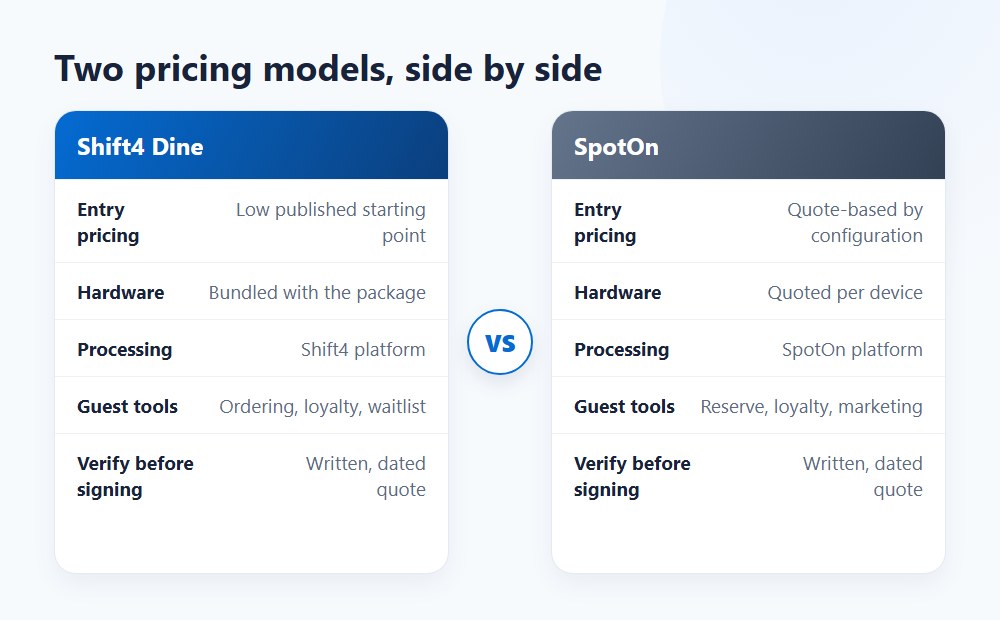
This is where many restaurant owners make the wrong decision. Sticker price is not total cost. The better value depends on software fees, payment rates, hardware structure, contract terms, and what add-ons you actually need. Understanding the hidden costs in Shift4 Dine before you sign is essential.
SpotOn publishes more visible pricing structure in the available materials. Shift4 Dine is easier to read as a bundled offer, but the final economics often depend on quote details, hardware subsidy terms, and annual fees that are not listed on the main pricing page. That means the headline price alone can mislead.
A practical example: one operator sees “$0/month” and stops reading. Another sees “$29.99/month per terminal” and assumes it is more expensive. Then the first quote includes higher processing, purchased hardware, and add-ons for loyalty or reservations. The second quote includes subsidized hardware and fewer paid modules. The result flips. Fees eat margin in ways that do not show up in the brochure.
That is why SpotOn POS pricing needs to be read together with processing and contract terms, not as a standalone number.
| Cost driver | Shift4 Dine | SpotOn |
|---|---|---|
| Base software | $29.99/mo per terminal | $0/mo All-In or $55/station/mo Essentials |
| Processing (card-present) | ~2.75% + $0.15 (third-party reported; not published) | 2.79% + $0.20 (All-In) / 2.45% + $0.15 (Essentials) |
| Hardware upfront | $0 in bundled promos (tied to 36-mo term) | Included on All-In; $750 (Station 15) / $375 (handheld) on Essentials |
| Contract length | 36 months (standard) | All-In: 24 months; Essentials: month-to-month |
| Loyalty | Free/included | $65/mo add-on |
| Reservations | Free/included | $100/mo + $250 setup fee |
| Annual per-device fees | ~$250 program fee + $190–$325 regulatory fee per device (third-party reported) | Plan-dependent add-ons; ETF details require direct quote |
| Early termination | Total Monthly Service Fee × months remaining | $995 + doubled software license to switch processor |
Contract Risks & Hidden Cost Warning
This deserves its own block. Both platforms carry meaningful lock-in costs that do not appear in headline pricing.
Shift4 Dine: The $29.99/month figure looks simple, but operators must also budget for annual program fees (~$250/device) and regulatory assurance fees ($190–$325/device/year) reported by third-party analyses — Shift4 does not publish these officially. The early termination fee equals your Total Monthly Service Fee multiplied by remaining months in the agreement. On a 36-month contract, exiting after year one can cost thousands. Yes, that math is uncomfortable. I’ve seen operators sign without running it.
SpotOn: Switching payment processors after signing triggers a $995 conversion fee and doubles your software license cost. Reviewers advise auditing monthly processing statements carefully, as billing discrepancies have been reported.
The safe rule before signing either agreement: ask for the complete addendum, including all annual per-device fees, the early termination formula, and what happens to your hardware if you exit early.
Pricing, processing terms, and hardware bundles can change by quote, location, volume, and restaurant profile. Information above is for orientation only and reflects 2025–2026 sources. Always verify current terms directly with vendors.
Software Fees, Hardware Costs, and Contract Length
Shift4 Dine usually looks simpler at the software line item. SpotOn usually gives you more plan variation. The risk is that both can look cheaper than they really are if you ignore hardware and term structure.
The strongest retrieved pricing points for Shift4 Dine are $29.99 per month per terminal and, in some offers, $0 upfront hardware. Partner materials indicate the free-hardware path is typically tied to a 36-month processing agreement. Separate configurations can carry meaningful upfront hardware costs when not subsidized: $494–$1,034+ per terminal and $627+ for a handheld in some setups.
SpotOn’s public pricing is more visible. Essentials is $55 per station per month with lower card-present processing, while All-In is $0 per station per month with higher processing and a two-year minimum term. Hardware examples include Station 15 at $995 (promoted at $750 in some offers) and handhelds from $375. That spread matters because hardware costs are not one fixed number.
In one migration project reviewed during research for this article, the owner focused on monthly software only. Rebuilding the model around three numbers instead — monthly software, effective processing cost, and exit cost after year one — changed the preferred option in one meeting.
That is the real lock-in test.
Pricing and processing terms are financial commitments that vary by individual business profile, volume, and negotiation. The figures in this section are for orientation only and reflect 2025–2026 sources. Verify all current terms directly with each vendor before signing.
Flat-Rate Processing vs Cash Discount Models
Both platforms support flat-rate processing logic. Both also touch cash discount or dual-pricing models. The better choice depends less on the POS brand and more on whether your guest base and check profile can handle that pricing approach cleanly.
Shift4’s standard card processing is commonly cited at 2.75% + $0.15 per transaction. Shift4 documents a cash discount / dual pricing path through its Advantage Program — and specifically notes that this is not a surcharge program. It frames it as a cash discount model, which is a meaningful legal distinction in several states.
SpotOn’s retrieved processing examples include 2.45% + $0.15 for card-present transactions on Essentials, 2.79% + $0.20 on All-In, and higher rates for keyed or online transactions. SpotOn documents dual pricing and explains the distinction between surcharge and cash discount — including the legal caution that surcharging is not permitted in all 50 states.
A casual bar with many low-ticket taps feels every extra 5 cents and every extra 0.20%. A full-service restaurant with larger checks may care more about percentage spread than per-item software fees. A coffee shop with a cash-light customer base may not benefit much from a cash discount model, even if the math looks attractive on paper. Know your average ticket before you model this out.
POS Features Compared: Ordering, Service, and Back-of-House Tools
Both products cover core restaurant POS workflows. Shift4 Dine looks stronger in the retrieved materials for explicit kitchen routing, floor logic, and centralized menu control. SpotOn looks strong on menu management and handheld execution, with a confirmed offline mode advantage.
This is one of those sections where brochures flatten real differences. A POS does not help because it “has modifiers.” It helps because modifiers are fast to use, route correctly to the kitchen, and do not slow down the floor staff during rush.
Shift4’s table-service materials explicitly state orders are sent directly to the kitchen, support QR and tableside ordering, and use customizable floor plans for real-time table status tracking. Pricing, promotions, and taxes can be centrally managed across locations, with local tailoring allowed (Shift4 Dine table-service page, 2025).
SpotOn’s back-of-house materials confirm menu items are managed with pricing, modifiers, tax settings, and display options for front-of-house order entry. SpotOn also maintains front-of-house user guides that support a complete restaurant stack (SpotOn BOH menu items documentation).
Handheld POS, Tableside Workflows, and Kitchen Display System
This is close. Both systems support handheld POS, tableside payments, and KDS routing. Shift4 Dine has a slightly clearer operational story in the retrieved sources for instant kitchen fire and table-service flow. SpotOn adds a confirmed offline mode for KDS that Shift4 does not explicitly confirm in retrieved materials.
SpotOn Handheld accepts tap, insert, and swipe at the table, supports Apple Pay and Google Pay, and works with SpotOn’s KDS, which shows order type, timers, table numbers, and guest counts. Orders go to the kitchen “the moment a guest is ready.” SpotOn’s KDS materials confirm the system can continue operating during internet disruptions — an important operational safeguard for restaurants with unreliable connectivity (SpotOn restaurant POS; SpotOn KDS).
Shift4’s handheld materials describe tableside ordering, EMV payments, tipping on device, and direct fire to the kitchen display “the moment they’re entered.” Handheld+ includes a built-in receipt printer for at-the-table receipts — a small feature until you run a room where guests want to close out fast without a return trip. Shift4 Dine’s KDS also features an All Day Summary view showing a real-time breakdown of all completed orders, improving kitchen oversight (Shift4 Dine, 2025). Explore the kitchen display system for Shift4 Dine for hardware and configuration options.
Offline Mode: A Critical Operational Factor
What happens when your internet goes down during a Friday dinner rush?
SpotOn’s KDS and ordering system is documented to keep operating during internet disruptions, with card acceptance continuing in offline mode. This matters operationally for restaurants in older buildings, areas with spotty connectivity, or any situation where an ISP issue could otherwise halt card acceptance.
Shift4 Dine does not have an equivalent confirmed offline mode in the retrieved official sources. Before signing, ask your Shift4 representative directly how the system behaves during internet outages and whether card payments can be captured offline. That is not a small question — it is a service continuity question.
In a bar rollout covered during research for this comparison, handheld routing fixed a simple but expensive problem: bartenders were batching orders verbally during peak volume. Switching to direct handheld entry with kitchen and bar routing rules tightened — ticket errors dropped and closeout speed improved. The hardware was not the magic. The workflow was.
That is how handheld POS should be judged.
Online Ordering and Omnichannel Restaurant Operations
Both vendors now cover first-party online ordering well enough for most restaurants. The practical difference is not whether online ordering exists — it is how cleanly menus, pricing, and order channels stay aligned with the in-store operation.
Shift4 Dine supports built-in online ordering through its Customer Hub and restaurant website flows. The product framing centers on reducing third-party platform fees, with separate surcharge logic for marketplace integrations such as DoorDash and Uber Eats orders.
SpotOn Order is positioned as commission-free online ordering through the restaurant’s own website. SpotOn publicly lists delivery integrations including DoorDash and Uber Eats directly, plus Grubhub, Postmates, and others through Deliverect. Both platforms cover the major aggregator ecosystem.
If 80% of digital orders still come from marketplaces, a beautiful first-party flow will not fix margin by itself. It helps when the restaurant already has repeat traffic and wants more direct ordering. If not, the bigger gain may come from menu cleanup, prep routing, and pickup timing discipline.
Marketing, Loyalty, and Guest Engagement Tools
SpotOn has the stronger public case for guest engagement depth. Shift4 Dine offers useful loyalty and reservation value in public pricing, but SpotOn’s marketing stack is better documented and more layered.
That does not mean SpotOn is the better POS for every restaurant. It means if retention and guest marketing are central to the buying decision, SpotOn deserves credit here.
Retrieved SpotOn materials point to loyalty, gift cards, review management, email marketing, SMS marketing as an add-on, and review prompts tied to guest checkout. SpotOn Marketing Assist (2025) automates personalized email and social media campaigns based on guest data — SpotOn claims operators save up to 5 hours per week on marketing tasks. Shift4 Dine’s Customer Hub supports email marketing campaigns and review monitoring, but text-based customer engagement is noted as not currently available in the retrieved U.S. material. That is a real gap if SMS is part of your repeat-visit strategy.
Loyalty Program, Reservations, and Repeat-Visit Tools
Shift4 Dine looks stronger on value here. SpotOn looks stronger on depth and explicit module design.
SpotOn Loyalty is priced at $65/month when added to SpotOn POS. SpotOn Reserve is priced at $100/month plus a $250 setup fee. Guest profiles are tied into the POS — loyalty only matters if the cashier or server does not have to fight the system to use it.
Shift4 Dine’s public pricing materials show FREE Marketing & Loyalty and FREE Reservations & Waitlist, which is a strong value message if those tools meet your actual operational needs. Public materials give less detail about loyalty mechanics and point logic than SpotOn’s module framing does. You can review Shift4 Dine’s reservations and waitlist management capabilities directly.
For many independents, free and good-enough beats paid and deeper. For reservation-heavy rooms, the answer may flip.
AI and Profit-Focused Tools as a Differentiator
This is the clearest feature category where SpotOn has a documented edge. Shift4 Dine has AI-adjacent activity in its ecosystem, but not a publicly confirmed built-in profit stack at the same level.
SpotOn launched Profit Assist in 2025 as an AI P&L analysis tool that connects to QuickBooks Online, Xero, and Restaurant365. SpotOn says it detects cost anomalies and provides recommendations around food cost, labor, and discounts, with average customer savings of 4.3% of total costs claimed in its materials. Real client results cited include a 9% decrease in cost of goods sold at one Alabama operator, $1,200 in annual savings at a Dallas-Fort Worth location, and $2,000 in instant savings at a San Diego restaurant.
In 2026, SpotOn launched Profit AI in open beta, combining POS, Reserve, Teamwork, Profit Assist, and third-party data into proactive profit recommendations. One beta restaurant (The Breakfast Brothers) acted on a Profit AI recommendation to add single-serve mimosas and saw a 5% increase in beverage spend. SpotOn also uses a public example of $44,000 annual savings on a restaurant with $65,000 monthly sales.
These are vendor claims, not independent field studies. However, broader industry research provides supporting context: according to Restaurant365 research (2026), among operators actively using AI, 61% reported lower food costs and 62% reported lower labor costs — with nearly a third seeing cost reductions of 6% or more.
Shift4’s related AI signal in the provided material is more limited. The strongest 2026 item is the Maple AI partnership for AI phone ordering, reported by Digital Transactions (Digital Transactions, 2026). Useful, but not equivalent to Profit Assist and Profit AI as a profit layer.
AI and restaurant marketing tools are the strongest public part of SpotOn’s competitive case.
Reporting, Analytics, and Management Visibility
Shift4 Dine is stronger than many buyers assume on day-to-day reporting. SpotOn has a good analytics story in public positioning, but public materials give more operational detail for Shift4 reporting than for SpotOn reporting.
Shift4 Dine’s Mobile App (Android and iOS) shows total sales, sales per ticket, average ticket time, open tickets, void usage, staff hours, sales, tips, and overtime. The broader Lighthouse reporting ecosystem adds dashboards, transactions, statements, exports, and enterprise extracts for third-party systems. Reports can be filtered by date and time, with CSV, Excel, and PDF export options (Shift4 Customer Hub Report Guide, 2026). Explore the full scope of Shift4 Dine reporting and analytics capabilities.
SpotOn publicly positions restaurant analytics software as part of the platform, tying reporting to food cost control, menu visibility, and profitability analysis. In public materials, there is less hard detail on report customization and manager mobile access than what exists for Shift4.
Lighthouse Reporting and Day-to-Day Restaurant Decisions
Lighthouse reporting is useful when managers need operational visibility without waiting for end-of-day reports. Its value is not “more data.” Its value is faster decisions around discounts, voids, labor, and menu performance.
Shift4’s Lighthouse Business Manager includes financial, operational, transaction, dashboard, and enterprise extract layers. Shift4 also documents discounts, voids, inventory, employee reports, and sales by item or order type as part of the broader reporting picture (Shift4 Lighthouse launch coverage).
A real manager use case is simple: if discounts spike on one shift, you need to know before payroll closes and before it becomes “just how that location operates.” The same goes for void abuse, open-ticket drag, or a promo that is selling volume but killing contribution margin. Banks love opacity — your reporting stack should not.
Sales Forecasting and Schedule Planning
Both platforms connect sales forecasting to labor planning. Shift4’s retrieved documentation is more explicit on the actual forecasting logic, while SpotOn’s scheduling stack clearly connects projections to schedules.
Shift4’s daily sales trend report uses a five-week lookback and can project sales for a given weekday based on the last five same weekdays’ average, then use that projection to schedule labor. SpotOn Teamwork supports POS-based sales projections and allows those projections to map across schedules, with trend-based or CSV-imported forecasting paths.
This matters because staffing is where POS reporting stops being academic. Overstaff one slow Tuesday and margin leaks quietly. Understaff one Friday and guest experience takes the hit immediately. The best way to schedule restaurant staff is to use sales forecasting to build more profitable schedules — and both platforms give you the data to do that, if you actually use it.
Ease of Use, Onboarding, and Customer Support
SpotOn has the stronger public usability and support reputation in retrieved review materials. Shift4 Dine has stronger confirmed field-support language in official materials. Those are not the same thing, and buyers should not confuse them.
SpotOn’s Capterra profile shows 4.2/5 for ease of use and 4.2/5 for customer service based on 371 reviews, with repeated user comments around easy training and user-friendliness. The same data also notes complaints about slow or inconsistent support in some cases — the support story is positive, but not flawless.
Shift4’s official pages explicitly state 24/7 technical support, 24/7/365 in-house support, and onsite installation and service from certified technicians. Customer reviews reinforce this:
“Very well trained professional work done right! Best POS by far! Definitely will recommend to all my business friends. I really love that they have real technicians that come to assist next day. And their customer service is excellent 24/7.” — Verified Shift4 Dine customer review
“I appreciate having real technicians who come to help the next day. That’s critical for keeping a restaurant running without interruption.” — Max Artemenko, Shift4 Dine Partners (case #12)
That creates a fair but important distinction:
- SpotOn has stronger public review signals.
- Shift4 has stronger retrieved official field-support specifics.
Learning Curve for Owners, Managers, and Staff
SpotOn appears easier to train quickly. Shift4 Dine is still trainable without drama, but the workflow depth can mean a longer ramp if the restaurant has more complex service logic.
Retrieved onboarding figures show SpotOn at 30–60 minutes per person for basic terminal operations. SkyTab-era training references for Shift4 Dine point to 2–3 hours per shift/group and sometimes 4 hours for cashiers and servers depending on scope. That spread makes sense: a simple counter workflow trains faster than a full-service floor using modifiers, split checks, tips, and multi-course pacing.
In practice, the training burden often comes less from the interface and more from setup quality. Well-built menus and clean modifier structure can make a “complex” system feel intuitive. A poorly configured “simple” system can feel painful from day one. I’ve seen both — and the configuration quality matters more than the brand.
What to Expect from Customer Support After Launch
Support quality matters most after the sale, during live service, and under pressure.
Shift4’s official materials state 24/7 technical support and a nationwide network of certified technicians for onsite installation and service. Phone, chat, and email support are documented — though one installation-support page limits live chat hours, so not every support channel is truly 24/7. Multiple client reviews confirm next-day technician availability as a practical differentiator.
SpotOn’s public reputation signals are strong — its 2024 G2 announcement emphasized “Best Support & Highest User Adoption,” and user comments highlighted the value of speaking to a real person during onboarding and support (Business Wire, 2024).
“The support test is simple: what happens at 7:30 p.m. on a Friday when a printer mapping breaks or a manager cannot close checks. That is the support you are buying.” — Max Artemenko, POS Systems Expert & Product Architect, Shift4 Dine Partners
Sources used for this section: SpotOn on Capterra; G2 comparison, 2026; Business Wire, 2024; official Shift4 Dine and SpotOn product pages.
Strengths and Weaknesses of Each System
Shift4 Dine wins on packaged value, payment alignment, and practical restaurant operations. SpotOn wins on public satisfaction, guest engagement depth, and AI-forward tooling. Neither is perfect.
Shift4 Dine vs SpotOn: Strengths and Weaknesses
System Strengths Weaknesses
Shift4 Dine Lower visible entry price; free/included loyalty and reservations; strong handheld/KDS/table-service flow; 24/7 support + technician network; $0 upfront hardware promos Annual per-device fees require scrutiny; mandatory 36-mo processing contract; no offline mode confirmed; less documented AI/marketing depth; processing rates not published
SpotOn Strong public support and user-adoption signals; Profit Assist + Profit AI stack; clearer published pricing; offline mode confirmed; good handheld and KDS coverage; stronger marketing suite Loyalty and Reserve are paid add-ons; switching processors triggers $995 fee + doubled license; no self-serve API; billing discrepancy complaints in reviews; hardware costs more upfront on Essentials
Where Shift4 Dine Has the Edge
Shift4 Dine has the edge when cost control, bundled hardware economics, and operational POS basics matter more than a broader growth-tech stack.
The biggest confirmed edge is value packaging: $29.99/month per terminal, frequent $0 upfront hardware promotion paths, and free or included loyalty plus reservations. For restaurants opening a location, replacing old hardware, or trying to avoid a large upfront capital hit, this matters. An overpriced POS with add-on creep can quietly drain margin for years.
The rebrand from SkyTab to Shift4 Dine did not change the product core — it aligned the name with the wider Shift4 platform (Shift4 release notes, 2026). If you evaluated SkyTab before and liked what you saw operationally, Shift4 Dine is the same system.
Where SpotOn Has the Edge
SpotOn has the edge when you prioritize guest engagement, reservations depth, AI tools, offline reliability, and stronger third-party satisfaction signals.
The strongest public evidence sits in four places:
- Review and user-adoption signaling (G2 #1 Fall 2026, Capterra 4.3/5)
- Guest-facing growth modules (loyalty, marketing, SMS, reservations)
- AI-assisted profitability tooling (Profit Assist + Profit AI)
- Confirmed offline mode for uninterrupted operations
SpotOn’s Profit Assist and Profit AI are not small add-ons — they are part of a broader attempt to sell operating insight, not just POS. For operators who think in retention and margin optimization, not only payments and service flow, SpotOn becomes easier to justify.
Which POS Is Better for Different Restaurant Types
The better POS depends on service model more than brand preference. Shift4 Dine is usually the better fit for value-focused operators and lean teams. SpotOn is often the better fit for reservation-heavy or growth-tool-heavy restaurants.
Best Fit for Full-Service and Reservation-Heavy Restaurants
SpotOn has the stronger public edge for reservation-heavy full-service environments. SpotOn Reserve combines reservations, waitlist, and event bookings in one platform, and SpotOn’s broader full-service framing includes complex modifications, coursing, table management, and online reservations. SpotOn’s reservations API covers seating, reseating, party-size change, unseating, and cancellation — the full guest lifecycle.
Shift4 Dine clearly supports menu coursing, reservations setup, and floor plan/table-turn logic. That is sufficient for many full-service restaurants. But if reservations are central to the business model — think 80+ covers on a Friday with a waitlist — SpotOn’s public materials present a more explicit guest-flow orchestration case.
Fine dining and upscale venues with complex floor management needs should also look at Lightspeed Restaurant before committing to either platform. Hotel restaurants with hybrid retail and F&B stacks may find neither option fully native without custom integration work.
Best Fit for Quick-Service, Counter-Service, and Lean Teams
Shift4 Dine is often the better fit for QSR, counter-service, bars, and lean-margin independents. If you need lower software costs, strong handheld or terminal basics, KDS support, and less add-on creep, Shift4 Dine makes sense. That is especially true for cafés, counter-service concepts, taprooms, and bars where speed and simplicity beat a large growth stack.
SpotOn still works in these environments. It just risks being a more expensive answer if the business will not actively use the extra marketing and reservation tooling. Paying $65/month for loyalty and $100/month for reservations at a food truck or pop-up concept is a markup trap — the math does not work unless you are actually driving repeat visits through those channels.
3-Year Total Cost of Ownership: Illustrative Scenario
The following is a simplified scenario for orientation only, using publicly available figures. Actual costs depend on your volume, negotiated rates, and specific configuration.
Hypothetical setup: 2 terminals + 2 handhelds, $50,000/month in card volume
| Cost Element | Shift4 Dine (Est.) | SpotOn Essentials (Est.) |
|---|---|---|
| Software (36 mo) | $29.99 × 2 × 36 = ~$2,159 | $55 × 2 × 36 = ~$3,960 |
| Hardware upfront | $0 (subsidized) | ~$2,250 ($750 × 2 station + $375 × 2 handheld) |
| Processing (36 mo) | 2.75% × $50K × 36 = ~$49,500 | 2.45% × $50K × 36 = ~$44,100 |
| Annual per-device fees (Shift4 est.) | ~$500–$575/yr × 2 devices × 3 yr = ~$3,000–$3,450 | N/A on Essentials |
| Loyalty/Reservations | Included | $65 + $100/mo × 36 = ~$5,940 |
| Estimated 3-year total | ~$54,659–$55,109 | ~$56,250 |
This scenario excludes ETF risk, negotiated processing discounts, setup fees, and other variables. Run your own numbers with actual quotes from both vendors before deciding.
Shift4 Dine vs SpotOn Alternatives to Consider
If your restaurant clearly fits one of these two models, you may not need a broader shortlist. If your priorities are unusual, you should expand the comparison before signing.
There is a reason people still search SpotOn vs SkyTab and SkyTab vs SpotOn. The naming changed, the market shifted, and older content still ranks.
Why Users Also Search SpotOn vs SkyTab
Because SkyTab and Shift4 Dine are the same product lineage. The query confusion is historical, not technical.
Shift4 announced in May 2026 that SkyTab POS would be rebranded as Shift4 Dine starting May 12, 2026. The product did not split. The name changed. When you see SpotOn vs SkyTab, read it as SpotOn vs Shift4 Dine, formerly SkyTab POS. Any comparison article still using “SkyTab” as the primary name is working from pre-May 2026 data — the product itself has not changed, but the branding has.
When to Expand the Shortlist Beyond These Two
Expand the shortlist if you need unusually open APIs, very large franchise-level control, or a very specific stack that neither vendor supports cleanly.
The restaurant POS market in 2026 offers strong alternatives depending on your use case:
- Toast — best for full-service restaurants, multi-location groups, and high-volume operations that need the deepest restaurant-native feature set. 38.6% market share in the RestaurantTools.ai scan. Starts at $0/month (Starter Kit) to $165+/month.
- Square for Restaurants — best for cafés, food trucks, and quick-service where simplicity and low upfront cost matter most. 18.3% market share in the same scan. Free tier is genuinely usable.
- Lightspeed Restaurant — best for fine dining, hotels, and multi-concept groups that need ingredient-level inventory, sophisticated floor management, and international capabilities. Starts at $69/month.
- Clover for Restaurants — best for counter-service and QSR with an open app marketplace. Hardware-inclusive bundles from $135/month on 36-mo plans.
Both Shift4’s integration depth and SpotOn’s API model carry practical limits for very large or highly custom deployments. Shift4’s integration is tied closely to its payments architecture. SpotOn’s API model is location-centric and not fully open self-serve — integration requires going through a sales rep or CSM, with no sandbox for independent developers. If you are evaluating hundreds of locations, highly custom integration needs, or an unusual hotel/retail hybrid stack, reviewing Toast, Square, and Lightspeed before committing makes sense.
Final Recommendation: Should You Choose Shift4 Dine or SpotOn?
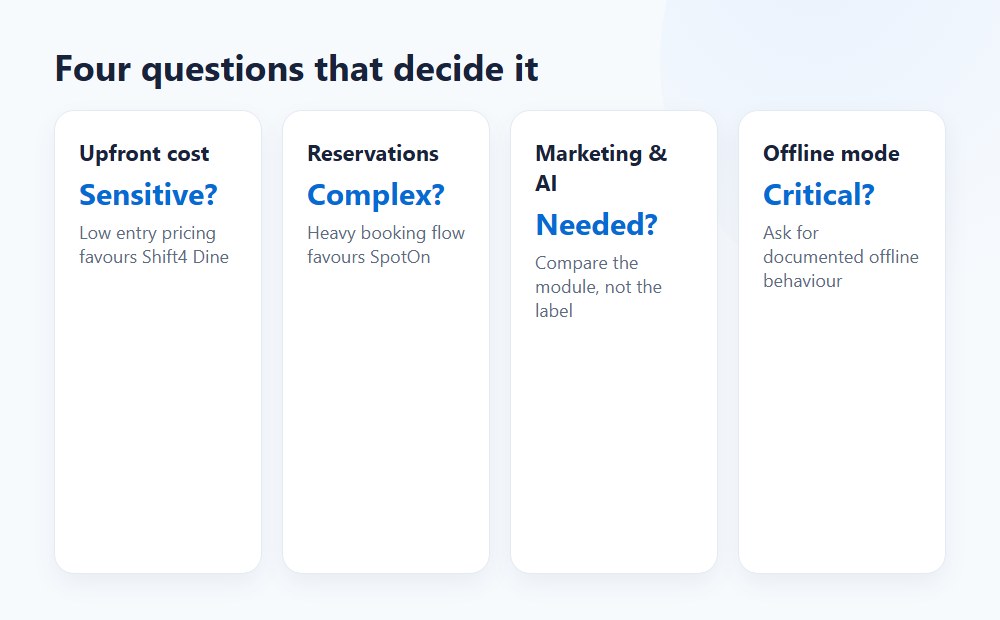
Choose Shift4 Dine if your priority is lower entry cost, bundled value, strong operational restaurant workflows, and practical payment economics. Choose SpotOn if your priority is guest engagement depth, reservations, confirmed offline mode, public support reputation, and AI-driven profitability tools.
After reviewing the 2025–2026 sources and weighing them against real implementation logic:
- Shift4 Dine is the better fit for more value-sensitive restaurants — especially new openings, bars, QSR/counter-service, and lean-margin independents where $0 upfront hardware and included loyalty/reservations reduce friction.
- SpotOn is the better fit for more growth-tool-driven restaurants — especially reservation-heavy full-service venues, operators who want AI-assisted P&L insights, and any restaurant where offline reliability is a critical risk factor.
If you came here after reading a SpotOn comparison page and wondering whether Shift4 Dine still makes sense: yes, it does — especially if you care about what the system costs to start, how it behaves on the floor, and whether bundled hardware and included modules reduce your monthly overhead.
But do not decide from marketing pages alone.
Looking for Current Promotions on Shift4 Dine?
Shift4 Dine Partners offers professional installation, 24/7 certified technician support, and transparent pricing consultation for restaurants considering Shift4 Dine. View current specials and promotions — including $0-upfront hardware offers and sign-on bonuses for qualifying restaurants.
Run Your Own Numbers Before You Decide
Compare these five numbers before any conversation with a sales rep:
- Monthly software cost per station
- Effective card-present processing rate
- Hardware upfront (or subsidized cost baked into the contract)
- Contract length and early termination cost
- Add-ons you will actually use (loyalty, reservations, AI tools)
That is where our verdict becomes your verdict. Check the Shift4 Dine pricing page and request a direct quote from SpotOn before you commit to either platform.
Caption: How to choose between Shift4 Dine and SpotOn in 2026 — decision framework for restaurant operators.
Sources used in this comparison include: official product and pricing pages from Shift4 Dine and SpotOn; SpotOn Business Wire and blog comparison pages; G2 and Capterra review data; Shift4 knowledge-base and reporting materials; RestaurantTools.ai market adoption data (2026); Restaurant365 AI research (2026); Digital Transactions (2026); partner and dealer documentation cited throughout.