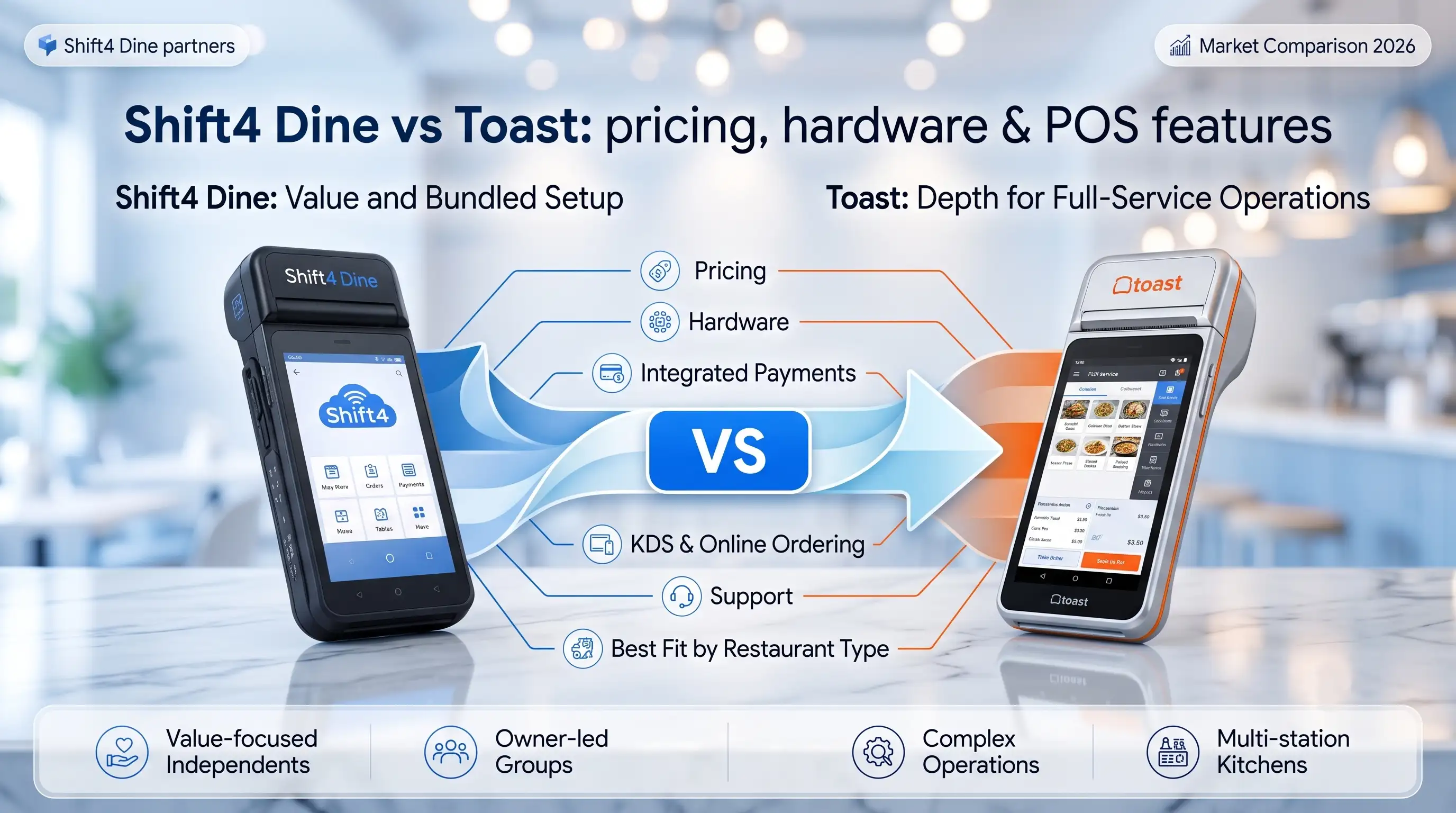
Shift4 Dine vs Toast: which restaurant POS fits your business?
TL;DR — The fast answer before you read further: Choose Shift4 Dine if you want bundled hardware, integrated payments, and


By Max Artemenko, POS Systems Expert & Product Architect, skytabpartners.us
Disclaimer: The information in this article is general in nature and does not substitute for professional consultation. Verify current pricing, features, and integration availability directly with SkyTab/Shift4 at skytab.com.
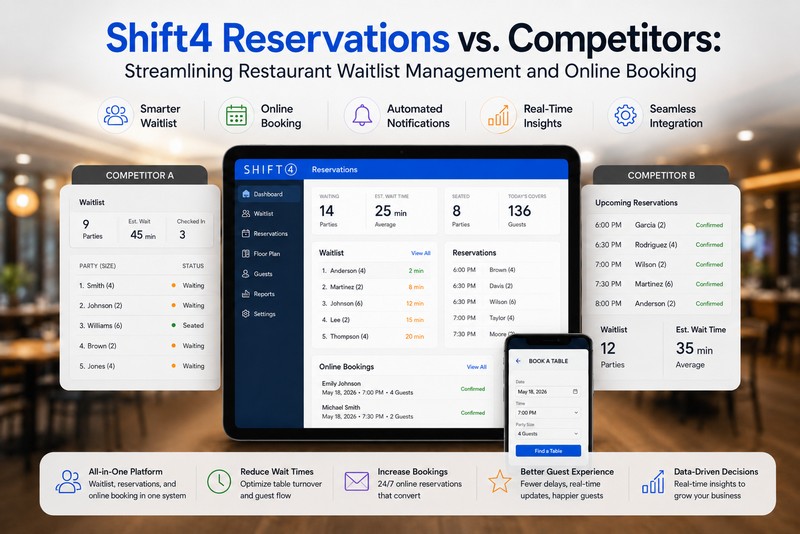
Modern restaurants are moving from paper-based waitlists to integrated digital solutions that unify online booking, real-time table tracking, and automated guest communication. SkyTab Reservations exemplifies this shift — cutting wait times, reducing no-shows, and improving guest experience through native POS integration and reservation automation built on Shift4’s infrastructure.
“Most reservation problems I see in restaurants aren’t about the software — they’re about running two systems that don’t talk to each other. A host managing a paper waitlist while the POS shows something different is a recipe for double-seating and frustrated guests. The moment you unify reservations, walk-ins, and table status in one platform, the host stand stops being a bottleneck and starts being a control center.”
— Max Artemenko, POS Systems Expert & Product Architect, skytabpartners.us
Disconnected reservation tools create operational drag that compounds during peak hours. Manual systems — paper waitlists, phone-in bookings, separate POS terminals — force hosts to reconcile conflicting data in real time, under pressure, with guests waiting. The result: double-seating, inflated wait estimates, and no-shows that go undetected until a table has sat empty for 20 minutes.
Integrated management systems solve this by connecting waitlist management, online booking, and POS synchronization into a single data layer. When a table turns, every touchpoint — host stand, kitchen display, online booking widget — updates simultaneously. The host stand shifts from reactive to strategic: staff can pace the floor, pre-assign tables, and communicate accurate wait times.
Online booking handles advance reservations — guests select a date and time, receive confirmation, and get automated reminders. Waitlist management handles real-time walk-in flow: guests join a digital queue and receive SMS updates on their position and estimated wait.
The operational gap between them is where most restaurants lose efficiency. According to OpenTable’s 2025 platform documentation, integration between the two systems allows no-shows and cancellations to auto-populate the waitlist — cutting table vacancy by up to 25% across 500+ US restaurants. Without integration, disjointed systems produce roughly 18% overbooking rates (SevenRooms Analytics, 2023).
SkyTab unifies both functions: advance bookings and walk-ins feed into the same real-time table management layer, with a single source of truth for availability.

SkyTab Reservations is not a bolt-on module — it is a native component of the Shift4 Dine ecosystem, built on Shift4’s infrastructure. The system unifies online booking, real-time queue management, and POS synchronization in a single platform — with no gap between front-of-house and back-of-house.
The system captures guest data at every interaction, automatically assigns tables based on party size and floor configuration, and gives staff an up-to-date picture of the entire dining room. Android hardware provides reliability for both standalone venues and multi-location groups.
Key capabilities:
Data based on official SkyTab documentation and operational experience from restaurant implementations in the US. Verify current feature availability at skytab.com.
POS integration is what separates a booking tool from a full reservation management system. When a host seats guests and updates the POS, that single action propagates in real time to every connected device: the online widget stops showing the table as available, the kitchen display registers an incoming order, and the manager dashboard reflects the current floor status. No calls, no manual updates, no delays.
Shift4 Dine’s integration with Shift4 Payments extends this synchronization into billing and analytics. Reservation data connects directly to check totals, tip processing, and revenue reporting — a guest visit that begins with a booking ends with a reconciled transaction in a single system.
The operational impact is concrete. Accurate table availability in the online widget means guests cannot book occupied tables. Walk-in guests see realistic wait times because the system reads actual table status rather than a static estimate. Hosts make seating decisions based on live data, not intuition.

The features that matter are those that reduce friction at the critical moments — when a guest decides whether to book, when they are waiting, and when they are seated.
Accurate wait time estimates use current table occupancy and historical turnover data to generate realistic projections. Guests who were promised 15 minutes and waited 35 do not come back. Automated SMS notifications handle communication at every stage without host involvement. According to Resy’s 2024 Operations Guide, digital notification systems manage 15–50 walk-in parties per hour — a volume that is physically impossible to handle manually. Intelligent table assignment matches a table to party size, preventing a couple from taking a six-top during peak hours.

SMS notifications simultaneously reduce no-shows and manage guest anxiety during the wait. SkyTab sends automated messages at critical moments: confirmation immediately after booking, a reminder 24 hours out, an alert one hour before the visit, and a table-ready notification.
Two-way SMS communication allows guests to confirm, modify, or cancel a reservation directly via text — without calling the host stand. This reduces inbound call volume and frees hosts for in-person service. Customizable message templates allow the restaurant to maintain its brand voice while the system automatically manages delivery timing. Learn more about waitlist management capabilities.
The SkyTab booking widget embeds directly on the restaurant’s website, adapting to brand colors, fonts, and tone. It displays real-time availability — guests see open slots and complete bookings without leaving the site. Mobile optimization is not optional here; it is a requirement. The majority of restaurant searches in the US now happen on smartphones, and a widget that requires pinch-to-zoom loses bookings.

Every reservation is a data point. Shift4 Dine’s integrated guest database captures preferences, dietary restrictions, special occasions, and visit history — building a profile that compounds in value over time. A returning guest’s profile tells the host that they prefer a corner table, tells the server about a shellfish allergy, and tells the manager that this is their third visit this month.
For multi-location operators, guest profiles sync across all locations. A guest who dines at your downtown location and then visits a suburban outpost receives equally personalized service — the data follows them.
“Restaurants that use CRM data to personalize service see measurable increases in repeat visit frequency. The mechanism is straightforward: guests who feel recognized return more often.” — Toast State of Restaurants Report, Toast Inc., 2025
This data also supports targeted marketing: identify frequent guests, flag those who haven’t visited in 60+ days, and measure campaign ROI by linking promotional activity directly to reservation and revenue data. A simple automation — “send a discount to guests who haven’t visited in 60 days” — is built directly from Shift4 Dine’s guest segmentation. Important note: SkyTab does not include a built-in loyalty program; loyalty integration requires a third-party connection.
Table turnover is the primary revenue lever within a service period. SkyTab recommends optimal seating based on party size, expected dining duration, and current table status. Small parties do not occupy large tables during peak hours. Tables with historically shorter occupancy times receive faster-cycling reservations.
The host stand dashboard shows a live floor map: which tables are occupied, which are turning in the next 5–10 minutes, and which walk-in guests are next in the queue. Hosts pre-assign incoming parties to tables that are about to clear, eliminating dead time between one party’s departure and the next seating. Kitchen displays receive advance notice of incoming orders, improving preparation pacing.
“In projects I’ve worked on, restaurants that configure Shift4 Dine’s table assignment logic correctly — matching party size to table type, setting accurate turnover time estimates by meal period — consistently report 15–20% improvements in covers per hour during peak service. The gains aren’t from working faster; they’re from eliminating dead time between turns.”
— Max Artemenko, skytabpartners.us

A no-show is lost revenue with no path to recovery. SkyTab addresses this through multi-layer confirmation: an automatic SMS 24 hours out, an alert one hour before the visit, and an optional two-way confirmation request that gives guests a simple way to confirm or cancel via text.
Guests who do not confirm within a set window are automatically moved to the waitlist, releasing the table for walk-ins — without host involvement. Walk-in management receives the same operational depth as advance bookings: arriving guests join a digital queue, receive an accurate wait time estimate, and get an SMS when their table is ready. They can wait at the bar or step outside — without being tethered to the host stand.
The dual approach — reducing no-shows while maximizing walk-in absorption — keeps the dining room at full capacity regardless of how the reservation-to-walk-in ratio shifts on any given evening.
Several dominant platforms serve the US restaurant market. Choosing the wrong one means paying for features you don’t use while missing the ones you need.
| Platform | Core Features | Pricing Model | Integración de POS | Built-in Loyalty | Best For |
|---|---|---|---|---|---|
| SkyTab | Reservations, waitlist, guest CRM, table management, Shift4 payments | Subscription $250–500/mo | Native (Shift4) | ❌ Third-party | Full-service restaurants, multi-location groups |
| Toast | POS, payments, inventory, online ordering, basic reservations | Subscription + processing fees | Native (Toast) | ✅ Yes | High-volume QSR, fast-casual chains |
| SpotOn | POS, payments, reservations, loyalty, marketing | Subscription + processing fees | Native (SpotOn) | ✅ Yes | Independent restaurants, budget-conscious operators |
| TouchBistro | POS, reservations, staff management, inventory | Subscription $69–399/mo + add-ons | Native (iPad) | ❌ Add-on | iPad-preferring table-service independents |
| OpenTable | Guest-facing reservations, marketplace discovery, basic CRM | Per-booking ($1–2) + subscription | Third-party API | ❌ Limited | Restaurants relying on third-party discovery traffic |
| Resy | Reservations, CRM, waitlist, analytics | Subscription-based | Third-party API | ❌ Limited | Fine dining, high-end restaurants |
| Tock | Reservations, prepaid bookings, events | Per-booking + subscription | Third-party API | ❌ Limited | Premium/fine dining, ticketed experiences |
For independent comparisons with user satisfaction ratings — G2 (g2.com) and Capterra (capterra.com) maintain current reviews in the restaurant POS category.
Both platforms are enterprise-grade but optimized for different priorities. Toast is built around payment processing and inventory management; reservations are a supporting function. It is well suited for high-volume QSR and fast-casual operations. SkyTab is purpose-built for full-service restaurants where reservations and queue management are the center of operations. Shift4 Dine’s table pacing logic, predictive analytics, and guest CRM depth are more developed than Toast’s reservation module. Toast has a broader third-party integration ecosystem and stronger tools for managing chains. Key distinction: both Toast and SpotOn include built-in loyalty programs; SkyTab requires a third-party integration.
SpotOn positions itself as an all-in-one platform with an interface designed for accessibility — training a non-technical employee requires minimal onboarding time. Shift4 Dine’s interface is denser in features: more capability, but a higher initial learning curve. For restaurants with high staff turnover or limited training resources, this is a real factor. The tradeoff is justified for operators who will use the advanced features: predictive analytics and cross-location guest profile synchronization.
The support model is a meaningful differentiator. Shift4 Dine provides a dedicated account manager and technical support. SpotOn relies more heavily on self-service documentation. For restaurants operating under high pressure, where downtime has immediate revenue consequences, Shift4 Dine’s dedicated support is a real operational advantage.
TouchBistro runs exclusively on iPad, using Apple’s closed ecosystem for visual polish and predictable performance. SkyTab runs on Android tablets, offering hardware flexibility and a lower per-unit cost ($300–500 vs. $400–800+ for iPad). Restaurants focused on premium aesthetics may prefer the iPad visual experience — this is a legitimate consideration for fine dining. Reliability is comparable: both platforms support 99.5%+ uptime under normal operating conditions.
OpenTable and SkyTab serve fundamentally different functions. OpenTable is a guest-facing reservation marketplace; its core value is driving new bookings through its consumer network. SkyTab is an operational platform managing reservations, the waitlist, and POS in a unified system.
OpenTable charges per booking ($1–2 per reservation) plus marketplace commissions, scaling linearly with volume. SkyTab uses a subscription model ($250–500/month) plus hardware costs. For restaurants building direct booking channels and seeking to own their guest data, Shift4 Dine’s subscription model delivers better long-term ROI — particularly when accounting for labor savings from integrated queue management and revenue recovery from reduced no-shows. Critical distinction: OpenTable owns the guest data generated through its platform. SkyTab data belongs to the restaurant — enabling direct marketing and CRM without platform dependency.
Shift4 Dine’s pricing model includes a monthly subscription ($250–350 for a single location, $150–250 per additional location for groups), hardware costs (Android tablets $300–800 per unit), and optional premium tiers ($400–500/month) with advanced analytics, loyalty integration, and priority support. No per-booking transaction fees.
ROI typically materializes within 6–12 months through three measurable channels: labor savings from automating guest communication, revenue gains through improved table turnover (15–20% more covers per hour), and revenue protection through reduced no-shows (20–30% reduction, based on US implementation experience). For a mid-size restaurant at 150 covers, these improvements generate annual revenue gains that exceed the software investment.
ROI Example — 150-cover restaurant:
| Metric | Baseline | With SkyTab | Annual Impact |
|---|---|---|---|
| Peak-hour covers | 100/hr | 115–120/hr (+15–20%) | +$50K–80K revenue |
| No-show rate | 15% | 10–12% (-20–30%) | +$15K–25K recovered |
| Host labor (reservation mgmt) | 15 hrs/wk | 8–10 hrs/wk | -$10K–15K labor cost |
| Estimated annual ROI | — | — | $75K–120K |
Figures based on operational experience from US restaurant implementations. Individual results depend on venue type, volume, and configuration.
The base subscription includes reservations and waitlist management, SMS notifications, guest database access, and standard reporting. Premium tiers ($400–500/month) add advanced analytics, loyalty program integration, and priority support with a dedicated account manager. An annual commitment typically reduces total cost by 10–15% compared to month-to-month pricing.
A typical restaurant needs 2–4 Android tablets (host stand, manager station, spare) at $300–800 per unit. Total hardware investment ranges from $600 to $3,200 before software. Shift4 offers hardware financing and placement programs for qualifying restaurants — in some cases providing tablets at reduced cost or no upfront charge in exchange for payment processing volume commitments. Evaluate total cost of ownership: hardware costs, financing terms, and processing rates together determine real ROI.
A successful SkyTab implementation follows a clear sequence: initial system setup (2–3 days), floor plan configuration (3–5 days), staff training (1–2 weeks), and ongoing optimization. Most restaurants reach full operational readiness within 2–3 weeks.
One pattern appears consistently: restaurants that designate a power user — a senior host or operations manager who becomes the internal SkyTab expert — get up to speed faster and extract more value from advanced features. That person becomes the first line of troubleshooting and the internal trainer for new staff.
The digital floor plan is the operational foundation of the entire system. Setup involves mapping the physical layout: table positions, sizes, special attributes (wheelchair accessibility, outdoor seating), and service zone assignments. Accuracy is critical — a misconfigured floor plan leads to overbooking, inefficient seating, and inaccurate wait time estimates. Most restaurants complete floor plan setup in 1–2 days. The most common mistake: not configuring combinable tables (two two-tops that push together into a four-top), which prevents the system from accounting for that flexibility during assignment. Test all configurations in Shift4 Dine’s sandbox environment before going live.
Structure training by role: hosts need depth in reservation management, queue operations, and table assignment; servers need access to guest profiles and visibility into special requests; managers need analytics, reporting, and configuration management. Plan for 4–8 hours of training per employee over 1–2 weeks. Schedule a follow-up session two weeks after launch.
Shift4 Dine’s support model combines a self-service knowledge base with direct access to specialists. Premium tiers include 24/7 access and dedicated account managers. Response times are generally 2–4 hours for standard issues, 30 minutes for critical operational problems.
“Shift4 Dine has been a heaven sent system for us. Their staff made the conversion so seamless. They have 24-hour customer service so you have access to getting any issues resolved at any time of the day 7 days a week.”
— Verified client review, Trustpilot/skytab.com
Shift4 Dine’s core strengths are reservation depth and operational integration. These two capabilities matter most for full-service restaurants managing complex guest flow.
Shift4 Dine’s limitations are contextual, not fundamental — but worth understanding before making a decision.
Shift4 Dine is built for full-service restaurants operating at 50+ covers per service period with complex reservation patterns — peak bottlenecks, mixed walk-in and advance booking flow, multi-section floor management. Multi-location operators gain significant benefit from unified guest profiles and centralized analytics.
SkyTab is less suited for QSR, ghost kitchens, or operations where reservations represent a small share of covers. If your primary challenge is payment processing efficiency or inventory management rather than reservation optimization, Toast or SpotOn may better match your operational priorities.
This assessment is based on analysis of SkyTab implementations across single-location restaurants and groups in the US, conducted through skytabpartners.us and Smart Payment Solutions. Max Artemenko has 12+ years of POS implementation experience in the US restaurant industry.
| Criterion | SkyTab | Toast | SpotOn | TouchBistro | OpenTable | Resy | Tock |
|---|---|---|---|---|---|---|---|
| Reservation Features | ⭐⭐⭐⭐⭐ | ⭐⭐⭐ | ⭐⭐⭐ | ⭐⭐⭐ | ⭐⭐⭐⭐ | ⭐⭐⭐⭐ | ⭐⭐⭐⭐ |
| Waitlist Management | ⭐⭐⭐⭐⭐ | ⭐⭐ | ⭐⭐⭐ | ⭐⭐⭐ | ⭐⭐ | ⭐⭐⭐ | ⭐⭐ |
| Integración de POS | ⭐⭐⭐⭐⭐ | ⭐⭐⭐⭐⭐ | ⭐⭐⭐⭐ | ⭐⭐⭐⭐ | ⭐⭐ | ⭐⭐ | ⭐⭐ |
| Built-in Loyalty | ❌ | ✅ | ✅ | ❌ | ❌ | ❌ | ❌ |
| Precios | $250–500/mo | Variable + processing | Variable + processing | $69–399/mo + add-ons | Per-booking + subscription | Subscription | Per-booking + subscription |
| Ease of Use | ⭐⭐⭐⭐ | ⭐⭐⭐⭐ | ⭐⭐⭐⭐⭐ | ⭐⭐⭐⭐ | ⭐⭐⭐⭐⭐ | ⭐⭐⭐⭐ | ⭐⭐⭐⭐ |
| Support | ⭐⭐⭐⭐⭐ | ⭐⭐⭐⭐ | ⭐⭐⭐ | ⭐⭐⭐⭐ | ⭐⭐⭐ | ⭐⭐⭐ | ⭐⭐⭐ |
| Best For | Full-service, multi-location | QSR, fast-casual | Independent, budget-conscious | iPad-preferring table-service | Discovery-dependent | Fine dining | Premium/ticketed |
Based on available documentation, SkyTab is not currently listed among Google’s approved “Reserve with Google” partners — which includes platforms such as OpenTable, Resy, and Tock (Google Business Profile Help, updated January 2026). Shift4 Dine’s booking widget integrates directly on the restaurant’s website and can be linked from a Google Business Profile listing, allowing guests to navigate to the booking page. However, native reservation completion within Google has not been confirmed as a current SkyTab capability. Verify the current integration status directly with the SkyTab team — partner lists are updated regularly.
Yes — multi-location management is a core SkyTab capability. A single manager account provides a centralized dashboard with real-time data across all locations: current covers, wait times, no-show rates, and revenue metrics per location. Guest profiles sync across all locations. Location-specific configurations remain independent while reporting consolidates at the group level.
Shift4 Dine is designed with offline resilience: the host stand tablet continues to accept reservations and manage the queue locally when internet connectivity is lost. Data is cached on the device and syncs automatically when the connection is restored. Features that require an active internet connection — real-time POS synchronization, SMS notifications, and online widget updates — are unavailable during outages. For restaurants in areas with unreliable connectivity, redundant internet connections (primary broadband plus a mobile hotspot) are the standard solution.
SkyTab collects guest contact information, reservation preferences, visit history, and payment data. Data is encrypted in transit and at rest using TLS 1.2+ and AES-256 protocols. SkyTab is PCI DSS compliant through Shift4 Payments infrastructure. Guest data belongs to the restaurant — SkyTab does not sell or share it with third parties, and restaurants can export their guest database at any time. For GDPR/CCPA compliance questions, verify Shift4 Dine’s security and privacy policy directly at skytab.com or contact the Shift4 compliance team, as certifications are updated periodically.
No. SkyTab does not currently include a native loyalty program — this is a meaningful distinction from Toast and SpotOn, both of which offer built-in loyalty. Loyalty integration with Shift4 Dine requires a third-party connection. If loyalty is a key operational priority, factor this into your platform evaluation.
Step 1: Assess Your Current Operations and Define Goals
Document your current state: daily reservation volume, current no-show rate, average wait time during peak hours, and labor hours spent on reservation management. These baseline metrics are the only way to measure ROI after implementation. Set specific, measurable goals: reduce no-shows by 25%, increase peak-hour covers by 15%, cut inbound calls to the host stand by 30%.
Transfer your physical layout into SkyTab: table positions, sizes, configurations, and service zones. Define reservation rules — minimum and maximum party size, reservation duration, buffer time between seatings. Configure combinable tables. Test all configurations in Shift4 Dine’s sandbox environment before going live. This phase takes 3–5 days.
Develop role-based training: hosts — reservation management and table assignment; servers — guest profile access; managers — analytics and reporting. Designate 2–3 power users who receive deeper training and become internal experts. Plan for 4–8 hours of training per employee over 1–2 weeks. Schedule a follow-up session two weeks after launch.
Run a soft launch: use SkyTab for half of reservations while maintaining your current system for the other half. Monitor performance: are reservations being logged accurately? Are SMS notifications delivering reliably? Are hosts managing under real service pressure? After 1–2 weeks of successful parallel operation, transition to 100% SkyTab.
Track key metrics weekly for the first 3 months: no-show rate, peak-hour covers, average wait time, and labor hours spent on reservation management. Compare against the baseline from Step 1. At the 3-month mark, conduct a formal ROI analysis: labor savings, revenue gains from improved table turnover, and revenue recovery from reduced no-shows.
Shift4 Dine’s analytics capabilities are underutilized in most implementations. The system captures rich operational data — reservation patterns, table occupancy duration, service timing, no-show rates by day and time slot — that most operators never analyze.
Analyze historical seating duration by table and party size. Pull this data monthly and look for patterns: do couples at table 5 average 42 minutes while the same party size at table 12 averages 58? Use these patterns to route fast-cycling reservations toward tables with historically shorter occupancy times during peak hours.
Identify and eliminate the peak-hour bottleneck. Track which tables consistently have the largest gap between one party’s departure and the next seating. One restaurant group I worked with identified that a section of four-tops near the kitchen had an average turnover gap of 12 minutes — not because of table turnover itself, but because hosts were waiting for server confirmation before seating. Fixing that communication protocol cut the gap to 4 minutes: 8 minutes recovered per turn, across 6 tables, over a 3-hour service.
Forecast no-shows and strategically overbook. Shift4 Dine’s historical data shows your no-show rate broken down by day, time slot, and party size. If Friday at 7:00 PM consistently loses 15% of reservations to no-shows — accept 115% capacity for that slot, filling the dining room without generating excessive wait times. Shift4 Dine’s predictive analytics can automate the overbooking recommendation based on historical patterns.
Segment guests by booking behavior. Identify high-value guests (frequent visits, large parties, high average check) and at-risk guests (frequent no-shows, long gaps since last visit). High-value guests receive priority seating and a personalized greeting. At-risk guests receive the full reminder sequence plus an optional incentive for confirmed attendance.
Use predictive analytics to forecast demand and optimize staffing. Shift4 Dine’s analytics engine forecasts demand based on historical booking patterns, day of week, and seasonal trends. Staffing to demand reduces labor waste while ensuring adequate coverage during volume spikes. Over a full year, optimized scheduling driven by Shift4 Dine forecasting data can reduce labor costs by 5–10% while maintaining service quality.
Ready to move from manual reservation management to an integrated system? Shift4 Dine’s implementation team will guide you through setup, floor plan configuration, and staff training — with dedicated support before, during, and after launch. Schedule a personalized demo to see how SkyTab performs against your restaurant’s specific operational profile.
Information reflects SkyTab product capabilities and pricing as of publication date. Verify current pricing, features, and integration availability directly with SkyTab/Shift4 at skytab.com. This content is maintained by skytabpartners.us, a specialized resource operated by Smart Payment Solutions (USA).
TL;DR — The fast answer before you read further: Choose Shift4 Dine if you want bundled hardware, integrated payments, and
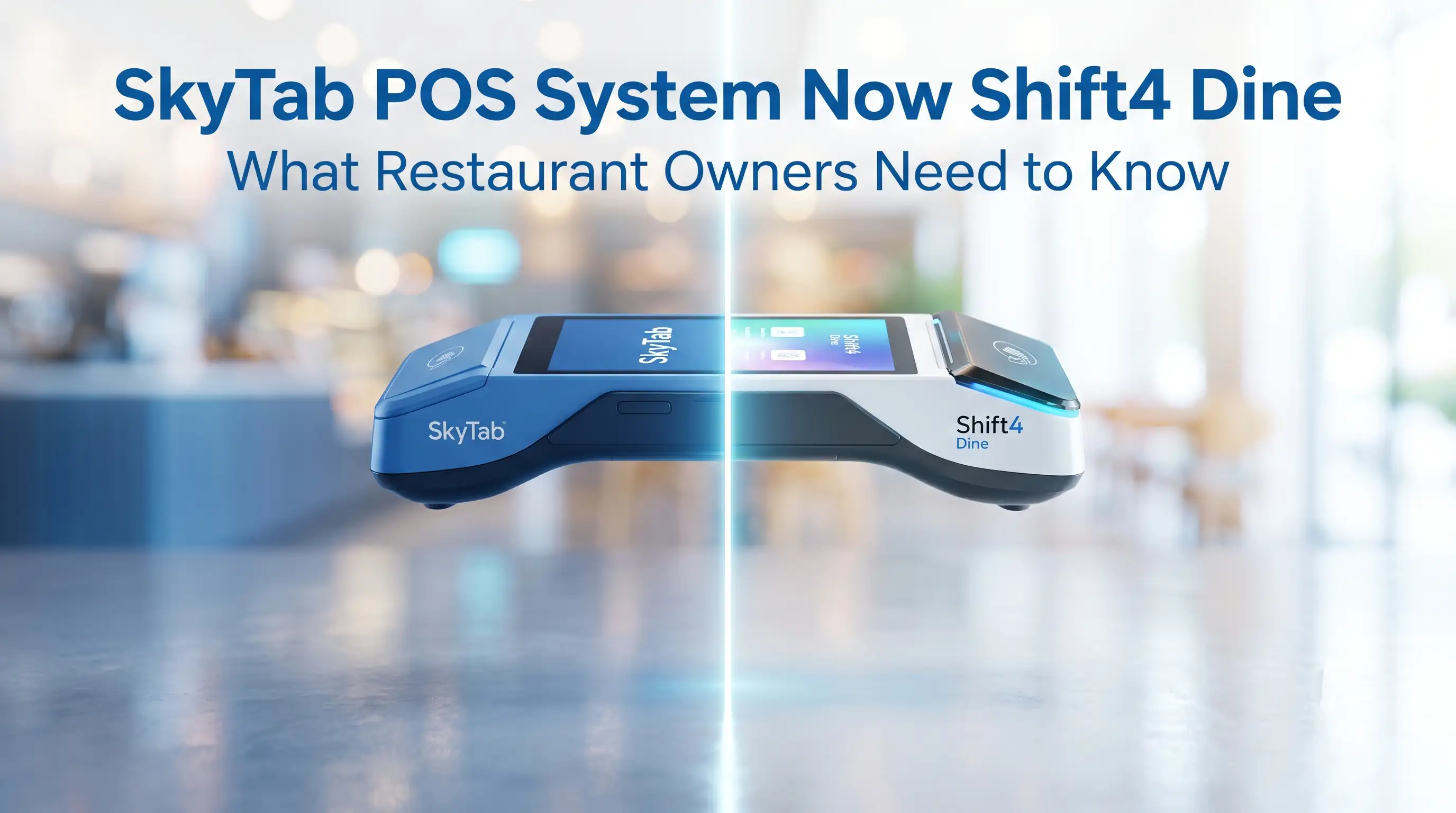
TL;DR: Shift4 Dine POS System (formerly SkyTab POS) is now officially presented as Shift4 Dine — same platform, same hardware, same 24/7 US-based support,



|
Other | Other | Other | |
|---|---|---|---|---|
| Upfront Hardware & Software | $0.00 | $5,750.00 | $3,358.00 | $3,798.00 |
| Instalación + Entrada al Menú | $0.00 | $999.00 | No ofrecido | No ofrecido |
| Monthly Support* | $79.98 | $240.00 | $200.00 | $249.00 |
| Total 1st Year Cost | $959.76 | $9,629.00 | $5,758.00 | $6,786.00 |
| Total 3rd Year Cost | $2,879.28 | $15,386.00 | $10,558.00 | $12,762.00 |